
An international team of scientists, including researchers from the Canary Islands Institute of Astrophysics (IAC), has confirmed the existence of three bodies orbiting the dynamic exoplanetary system TOI-201. They include a super-earth (TOI-201 d), a warm Jupiter (TOI-201 b) and a brown dwarf (TOI-201 c). The paper is published in Science Advances.
“The goal was to characterize the TOI-201 planetary system to understand not just what planets are there, but how they interact with each other dynamically,” said Ismael Mireles, a PhD candidate in the UNM Department of Physics and Astronomy and the first author of the article. “This helps scientists understand how planetary systems like our own Solar System form and evolve over time.”
A laboratory for studying planetary systems
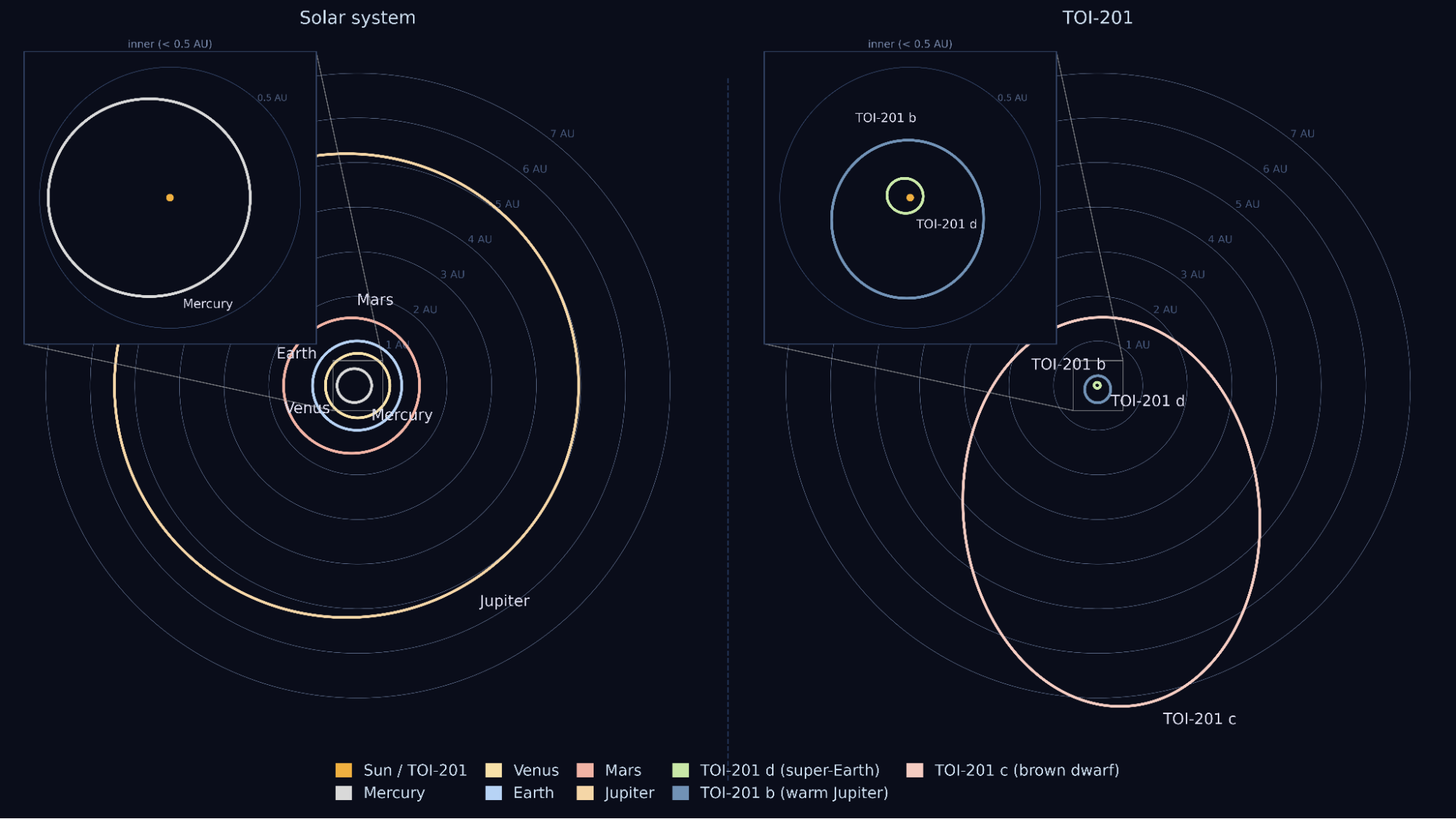
The Super-Earth (TOI-201 d) is a rocky planet roughly 1.4x Earth's size and approximately 6x Earth's mass, completing one orbit every 5.85 days. It is very close to its star and likely too hot for liquid water.
Warm Jupiter (TOI-201 b) is a gas giant about half the mass of Jupiter orbiting every 53 days. "Warm Jupiters" sit between closer in "hot Jupiters" (few-day orbits) and further out cold, distant gas giants like Jupiter (~12 years). They're scientifically interesting because astronomers don't fully understand how they got to the orbits they are found in.
Brown dwarf (TOI-201 c) is the most massive body in the system besides the star, on a wide, highly elliptical approximately 8-year orbit. Its gravitational influence is responsible for most of the system's dynamic behavior. TOI-201 c is also the longest-period transiting object ever to be discovered.
“TOI-201 c is unique because of its extremely long orbital period (~7.9 years) and its location in a system with two interior planets,” says Mireles. “Most known transiting brown dwarfs orbit much closer to their stars.”
“Since the mass of TOI-201 c is near the boundary separating massive planets from brown dwarfs, one mystery this system poses is whether this body formed like a planet or like a star,” explains Felipe Murgas a researcher at the IAC and co-author of the study.
To put this into perspective, a brown dwarf is 13 times more massive than Jupiter, but still too small to be classified as a true star. It cannot sustain hydrogen fusion in its core like the Sun can.
“This is one of only a handful of systems where planetary orbits can be watched actively changing on human timescales. It offers a rare real-time window into the dynamic lives of planetary systems,” Mireles explains. In fact, in 200 years only two of the three objects will still be transiting.
Four techniques for uncovering the system
The researchers used a combination of four observational techniques to confirm the system. The first is spectroscopy (radial velocities), which measures the star’s wobble caused by orbiting planets, and helps determine their masses. “We used multiple spectrographs in Chile: CORALIE, HARPS, and PFS. We also used archival data from the FEROS spectrograph in Chile and MINERVA-Australis in Australia,” explains Mireles.
The second technique is transit photometry, which involves recording the star dim slightly as a planet passes in front of it. Transits from NASA’s TESS space telescope and ground-based observations from the ASTEP telescope in Antarctica – a project led by the Observatoire de la Côte d’Azur, Nice, in partnership with the University of Birmingham and the European Space Agency - were used. Transit observations from the LCOGT global network of telescopes sites based in Chile, Australia, and South Africa were also included, and played a critical role in the analysis. “The LCOGT network enables more efficient monitoring of transits by utilising robotic telescopes at various sites and in different countries. This increases our chances of collecting data on these types of exoplanetary systems,” says Murgas.
The third technique included Transit Timing Variations (TTVs), which measures tiny deviations in the time when a planet’s transits occur, signaling the presence of another planet’s gravitational pull. IAC researchers Judith Korth and Hannu Parviainen, who are also co-authors of the study, carried out the TTV analysis, which helped to characterise the system’s architecture. Finally, the researchers utilized astrometry, which employs data from the Hipparcos and Gaia space missions to detect tiny shifts in the star's position on the sky caused by an unseen massive companion.
Traffic that disappears… and returns
Mireles goes on to say that exoplanet observations usually show just a snapshot of a system’s evolution. Indeed, most systems only change on timescales of millions of years. What makes TOI-201 special is that the researchers are actually able to watch it change in real time. “The planets' orbits are tilted relative to each other, and because of that, they're slowly pulling each other into new orientations,” says Mireles.
“This was a surprise, because if planets are being born in the plane of the protoplanetary disk that existed early in the life of the star, they are expected to have aligned orbits, like the planets in the Solar System. So the next question to answer for TOI-201 is how these three objects ended up with such tilted orbits,” adds Murgas
In 200 years, the Super-Earth will stop transiting. A few hundred years later, the warm Jupiter will stop transiting and later on, the brown dwarf will stop transiting. However, they will start transiting again thousands of years in the future, since they undergo cycles of transiting and non-transiting configurations.
The next transit of TOI-201 c is predicted for March 26, 2031, which will provide a rare opportunity for follow-up observations worldwide, including by citizen scientists.
“It was truly a multi-year, large team effort to study this system. Every new transit observation from ASTEP and LCOGT and every new RV measurement gradually lifted the veil and helped uncover the three-dimensional architecture of the TOI 201 system. And this unique architecture is at the heart of the system’s previously unseen dynamical interactions,” concludes Mireles.
Article: Ismael Mireles et al. “Uncovering the Rapidly Evolving Orbits of the Dynamic TOI-201 System”, SCIENCE ADVANCES, 15 Apr 2026, Vol 12, Issue 16. DOI: https://www.science.org/doi/10.1126/sciadv.aef2618
Contact at the IAC:
Felipe Murgas, fmurgas [at] iac.es (fmurgas[at]iac[dot]es)
Judith Marie Korth, judith.korth [at] iac.es (judith[dot]korth[at]iac[dot]es)
Hannu Parviainen , hannu [at] iac.es (hannu[at]iac[dot]es)
Enric Pallé: epalle [at] iac.es (epalle[at]iac[dot]es)