News

This section includes scientific and technological news from the IAC and its Observatories, as well as press releases on scientific and technological results, astronomical events, educational projects, outreach activities and institutional events.

Displaying 1 - 6 of 2862
Advertised on
  • Imagen de portada del libro ‘Eclipses. El Sol y sus eclipses en la ciencia, la historia y las artes’ /
    Los seres humanos han seguido los movimientos regulares del Sol y la Luna desde las civilizaciones más remotas y a lo largo y ancho del planeta Tierra. Ocasionalmente, el Sol se oscurecía o la Luna se teñía de rojo y esto dio lugar a múltiples interpretaciones más o menos disparatadas. A menudo estos eventos se consideraron como signos de malos augurios, aunque también inspiraron mitos de carácter más lúdico e incluso amoroso. Con ocasión de los tres eclipses solares que serán visibles desde España en 2026, 2027 (totales) y 2028 (anular) y que constituyen una tríada astronómica excepcional
    Advertised on
  • An artistic impression of a nanojet ejection triggered by the interaction of two magnetic flux ropes within a coronal loop in the Sun’s atmosphere.
    An international team of researchers led by the Instituto de Astrofísica de Canarias (IAC) and the Universidad de La Laguna (ULL), has unveiled a breakthrough explanation for the origin of tiny, jet-like plasma ejections in the solar atmosphere, known as “nanojets.” These elusive events which are recently discovered by the NASA’s solar telescopes are thought to play an important role in heating and sustaining the solar corona at temperatures above one million Kelvin. Why Study Nanojets? For decades, solar physicists have been puzzled by the so-called “coronal heating problem.” While the Sun
    Advertised on
  • Participants of the ExGal-Twin Radio Astronomy in Groningen (13-14 April 2026).
    From 13 to 17 April 2026, the University of Groningen (The Netherlands) hosted the ExGal-Twin 2nd Radio Astronomy School and 2nd Project Meeting, key activities of the European project ExGal-Twin, coordinated by the Instituto de Astrofísica de Canarias (IAC). The event brought together researchers, students and technical staff from the IAC and the partner institutions: the Kapteyn Astronomical Institute (University of Groningen), the Institute for Computational Cosmology (Durham University), and the Observatoire Astronomique de Strasbourg (CNRS), reinforcing scientific collaboration and
    Advertised on
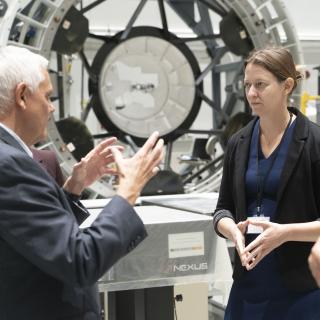
  • De izquierda a derecha, José Alonso Burgal, gestor; Valentín Martínez Pillet, director del Instituto de Astrofísica de Canarias (IAC); Alfonso Ynigo Rivera, ingeniero de sistemas; y Álex Oscoz, jefe del Departamento e investigador principal de IACTEC Espacio, durante su participación en el Space Symposium 2026.
    The Instituto de Astrofísica de Canarias is taking part in the 41st edition of the leading international space forum, held in Colorado Springs from 13 to 16 April, within the Spain Pavilion organised by ICEX alongside 16 other organisations from the sector. The Instituto de Astrofísica de Canarias (IAC), through IACTEC Space, its department dedicated to the development of technology for small satellites, took part this week in Space Symposium 2026, held in Colorado Springs, Colorado, USA, from 13 to 16 April. The event, organised by the Space Foundation and now in its 41st edition, is the
    Advertised on
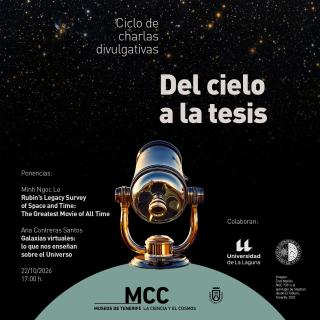
  • Cartel de la próxima sesión de Del Cielo a la tesis / IAC
    El Museo de la Ciencia y el Cosmos , del Organismo Autónomo de Museos y Centros del Cabildo de Tenerife, acogerá el próximo miércoles 23 de abril a las 17:00 horas una nueva entrega del ciclo de divulgación científica titulado “Del cielo a la tesis”, una iniciativa organizada por el alumnado del Instituto de Astrofísica de Canarias (IAC) y la Universidad de La Laguna (ULL). El ciclo, impulsado por estudiantado de doctorado del IAC, tiene como objetivo acercar a la ciudadanía los principales temas de investigación en Astrofísica narrados en primera persona por quienes los desarrollan. Las
    Advertised on
  • Necklace
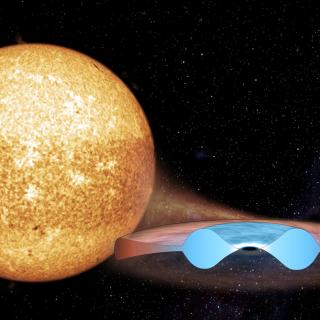
    The Necklace nebula is a bipolar, post-common-envelope planetary nebula, the central star of which has been shown to have a dwarf carbon star companion. We aim to understand the origins of the Necklace and its dwarf carbon central star. We study the carbon abundance of the nebula through far-ultraviolet spectroscopy obtained with the Hubble Space Telescope. Furthermore, through simultaneous modelling of multi-band light and velocity curves, we attempt to constrain the parameters of the central star system. Puzzlingly, we find that the region of the inner nebula observed with the Hubble Space
    Advertised on