
Bibcode
Kálmán, Sz.; Simon, A. E.; Deline, A.; Csizmadia, Sz.; Szabó, Gy. M.; Ehrenreich, D.; Wilson, T. G.; Günther, M. N.; Heitzmann, A.; Sousa, S. G.; Farnir, M.; Bonfanti, A.; Smith, A. M. S.; Pal, A.; Scandariato, G.; Adibekyan, V.; Brandeker, A.; Charnoz, S.; Akinsanmi, B.; Barros, S. C. C.; Song, X.; Alibert, Y.; Alonso, R.; Bárczy, T.; Navascues, D. Barrado; Baumjohann, W.; Benz, W.; Billot, N.; Biondi, F.; Borsato, L.; Broeg, C.; Collier Cameron, A.; Corral van Damme, C.; Correia, A. C. M.; Cubillos, P. E.; Davies, M. B.; Deleuil, M.; Demangeon, O. D. S.; Demory, B. -O.; Derekas, A.; Edwards, B.; Egger, J. A.; Erikson, A.; Fortier, A.; Fossati, L.; Fridlund, M.; Gandolfi, D.; Gazeas, K.; Gillon, M.; Güdel, M.; Guterman, P.; Hasiba, J.; Helling, Ch.; Isaak, K. G.; Kiss, L. L.; Korth, J.; Lam, K. W. F.; Laskar, J.; Lecavelier des Etangs, A.; Leleu, A.; Lendl, M.; Magrin, D.; Maxted, P. F. L.; Merín, B.; Mordasini, C.; Munari, M.; Nascimbeni, V.; Olofsson, G.; Ottensamer, R.; Pagano, I.; Pallé, E.; Peter, G.; Piazza, D.; Piotto, G.; Pollacco, D.; Queloz, D.; Ragazzoni, R.; Rando, N.; Rauer, H.; Ribas, I.; Santos, N. C.; Ségransan, D.; Stalport, M.; Sulis, S.; Udry, S.; Ulmer, B.; Ulmer-Moll, S.; Van Grootel, V.; Venturini, J.; Villaver, E.; Walton, N. A.; Wolf, S.; Zingales, T.
Bibliographical reference
Astronomy and Astrophysics
Advertised on:
9
2025
Journal
Citations
1
Refereed citations
1
Description
Context. Despite the ever-increasing number of known exoplanets, no uncontested detections have been made of their satellites, known as exomoons. Aims. The quest to find exomoons is at the forefront of exoplanetary sciences. Certain space-born instruments are thought to be suitable for this purpose. We show the progress made with the CHaracterising ExOPlanets Satellite (CHEOPS) in this field using the HD 95338 planetary system. We present a novel methodology as an important step in the quest to find exomoons. Methods. We utilised ground-based spectroscopic data in combination with Gaia observations to obtain precise stellar parameters. These were then used as input in the analysis of the planetary transits observed by CHEOPS and the Transiting Exoplanet Survey Satellite (TESS). In addition, we searched for the signs of satellites primarily in the form of additional transits in the Hill sphere of the eccentric Neptune-sized planet HD 95338b in a sequential approach based on four CHEOPS visits. We also briefly explored the transit timing variations of the planet. Results. We present refined stellar and planetary parameters, narrowing down the uncertainty on the planet-to-star radius ratio by a factor of ten. We also pin down the ephemeris of HD 95338b. Using injection-and-retrieval tests, we show that a 5σ detection of an exomoon would be possible at RMoon = 0.8 R⊕ with the methodology presented here. Conclusions. We exclude the transit of an exomoon in the HD 95338 system with RMoon ≈0.6 R⊕ at the 1σ level. The algorithm used for finding the transit-like event can be used as a baseline for other similar targets, observed by CHEOPS or other missions.
Related projects

Exoplanets and Astrobiology
The search for life in the universe has been driven by recent discoveries of planets around other stars (known as exoplanets), becoming one of the most active fields in modern astrophysics. The growing number of new exoplanets discovered in recent years and the recent advance on the study of their atmospheres are not only providing new valuable
Enric
Pallé Bago
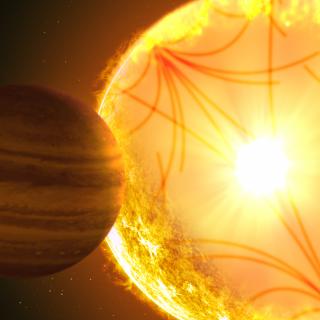
Helio and Astero-Seismology and Exoplanets Search
The principal objectives of this project are: 1) to study the structure and dynamics of the solar interior, 2) to extend this study to other stars (either single or in binary systems), 3) to search for extrasolar planets using photometric methods (primarily by transits of their host stars) and their characterization with complementary radial
Savita
Mathur