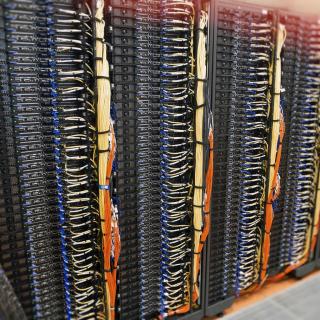

The Instituto de Astrofísica de Canarias (IAC) has successfully completed a technological milestone of great significance: the “Redundancy of the RedIRIS Tenerife–La Palma Maritime and Terrestrial Optical Network” project. This new and robust optical communications network guarantees the continuity of the data highways for the Canary Islands’ observatories — the Teide Observatory (OT) in Tenerife and the Roque de los Muchachos Observatory (ORM) in La Palma — ensuring their connectivity in the event of any technical or environmental contingency. This achievement is the result of a joint effort between RedIRIS and the Secretary of State for Telecommunications and Digital Infrastructure (SETELECO), with a total investment of over 23 million euros, funded by the European Union through the NextGenerationEU funds under the Recovery, Transformation and Resilience Plan (PRTR).
The solution is divided into two main sections contracted under rights-of-use (IRU) agreements. On the one hand, the submarine section has involved an investment of 16,800,000 euros and guarantees the IAC a minimum transmission capacity of 1.5 Tbps for the next 25 years. This roll-out directly links the islands of La Palma and Tenerife, whilst also connecting the latter to the mainland via high-speed 10 Gbps and 100 Gbps optical channels. Furthermore, the terrestrial upgrade had a budget of 5,811,796 euros and a 30-year right of use. This section provides two main links, each comprising two pairs of dark fibre, establishing a redundant connection between the La Palma Centre for Astrophysics (CALP) and the ORM, and between the headquarters in La Laguna and the OT.
Beyond the strictly scientific sphere, the roll-out of this powerful infrastructure by the successful bidders will open the door for the local community and other public institutions to establish a stable connection to such remote locations as Mount Teide and Roque de los Muchachos. This will enable the implementation of state-of-the-art solutions for emergency management on mountain peaks and in national parks, the promotion of digital tourism and astro-tourism initiatives, and a general improvement in connectivity services across the entire geographical area.
This greatly enhances the value of an infrastructure that is key to the future of science. State-of-the-art telescopes need to constantly process and transmit enormous volumes of data, and by doubling the network capacity, the IAC completely eliminates the risk of data loss or disconnections in the middle of observations. With this technological leap forward, the Canary Islands are cementing their position on the international stage as an extremely secure, competitive region that is well-equipped to host the most advanced astronomical projects, attracting the attention of major international scientific consortia.