
Clues to the first stars may be hiding much closer to home than expected. An international team led by the Instituto de Astrofísica de Canarias (IAC) has detected potential chemical traces of the very first stars in the Universe within a neighboring galaxy. The setting for this discovery is NGC 1277, a well-known "relic" galaxy. While normal galaxies grow and transform by merging with others throughout their history, this compact system formed most of its stars very quickly in the early Universe and became frozen in time. Acting as a cosmic time capsule, this galaxy is perfect for deciphering, from Earth, the same type of primitive galaxies that the James Webb Space Webb Telescope (JWST) is currently discovering in the far reaches of the Universe.
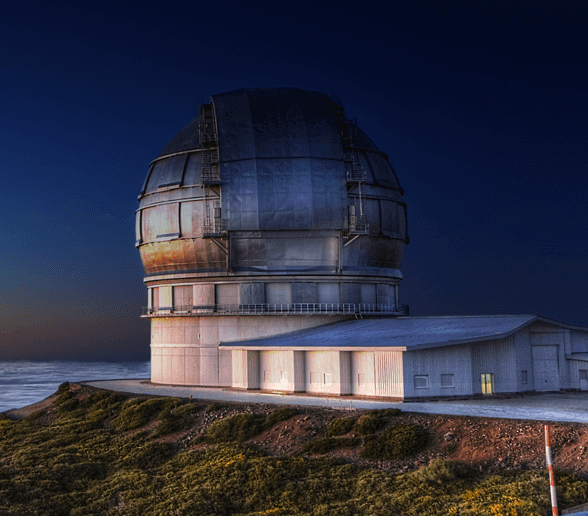
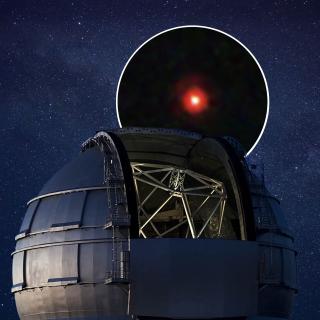
Using the EMIR instrument on the Gran Telescopio de Canarias (GTC) —the world's largest optical-infrared telescope—, at the Roque de los Muchachos Observatory (La Palma), the team captured an unusually intense chemical signal of silicon in this galaxy. "Infrared light allows us to identify chemical elements that are very difficult to study with other types of observations. In NGC 1277, we found a much higher amount of silicon than has been observed in any other galaxy so far. This peculiar composition suggests that the galaxy preserves the traces of some of the first generations of stars" explains Elham Eftekhari, lead author of the study, who carried out this work during her postdoctoral stage at the IAC and currently works at the Leiden Observatory.
Typically, silicon and magnesium form inside massive stars and scatter through space in similar proportions when these stars die and explode as supernovae. However, in this galaxy, silicon levels skyrocket compared to magnesium. This anomaly indicates that the gas was enriched by the cosmos' first massive stars: Population III stars, which produced the first heavy elements in history upon exploding. "We are not directly observing the first stars, which disappeared billions of years ago. What we are seeing is a potential chemical fingerprint that these very massive early stars left behind in subsequent generations of stars" notes Alexandre Vazdekis, study co-author and IAC researcher.
This is precisely what makes these time capsules, relic galaxies, such powerful laboratories. While the JWST attempts to search for primitive galaxies in the most distant corners of the Cosmos, the GTC proves that we can study that same cosmic infancy right next door, in high definition. "NGC 1277 is unique because it formed most of its stars at a very early stage in the history of the Universe and then evolved almost passively. While other normal galaxies have erased their original chemical signatures by mixing with others, NGC 1277 has managed to preserve that excess of silicon intact, acting as the fossil record of the infancy of the Universe" emphasizes Anna Ferré-Mateu, study co-author and IAC researcher.
Detecting such subtle chemical signals requires extreme precision that is only within reach of the most powerful ground-based telescopes, like the GTC. "This result was made possible thanks to high-quality observations with the 10.4-meter GTC. The near-infrared data have opened a window into the detailed chemical composition of one of the best examples of a massive relic galaxy, becoming the key to understanding the first steps of galaxy formation" says Michael Beasley, also study co-author and IAC researcher. To explain this excess of silicon, scientists point to pair-instability supernovae, theoretical explosions that completely destroyed the most massive stars of the early Universe. While this theory best fits the data, the team notes that other pathways of enrichment associated with very massive stars could have also contributed to this chemical recipe.
This discovery opens a new avenue for studying the first generations of stars without leaving our nearby Universe, revealing key clues about how the first galaxies formed. Furthermore, the finding provides a valuable roadmap for the James Webb Space Telescope, which can now search for these same chemical footprints in the most distant galaxies of the Universe.
| This work was supported by the MCIN/AEI and the European Regional Development Fund (ERDF) through project PID2021-123313NA-I00; by the Spanish Ministry of Science, Innovation and Universities through grants PID2022-140869NB-I00 and PID2024-162088NB-I00; under the IAC project TRACES. Additional support was provided by the INAF mini-grant 1.05.23.04.01, the Ramón y Cajal fellowship RYC2021-031099-I, the “la Caixa” Foundation fellowship LCF/BQ/DI23/11990084, and the Dutch Research Council (NWO) Vici grant VI.C.222.047. |
Article: Eftekhari, E., Ferré-Mateu, A., Vazdekis, A., La Barbera, F., Beasley, M. A., Benedetti, J. P. V., Kriek, M. “Chemical Hints of Population III Stars on Silicon Abundances in Massive Galaxies”, Accepted for publication in Astronomy & Astrophysics, 2026. DOI/link: http://arxiv.org/abs/2606.17153
Scientific contacts:
Elham Eftekhari, Leiden Observatory / Instituto de Astrofísica de Canarias: elham [at] strw.leidenuniv.nl (elham[at]strw[dot]leidenuniv[dot]nl)
Anna Ferré-Mateu, Instituto de Astrofísica de Canarias: anna.ferre [at] iac.es (anna[dot]ferre[at]iac[dot]es)
![The ultra-diffuse galaxy KKS2000]04 (NGC1052-DF2).](/sites/default/files/styles/crop_square_2_2_to_320px/public/images/news/nt030619.jpg?h=bc8a2161&itok=5XOM-hsd "The ultra-diffuse galaxy KKS2000]04 (NGC1052-DF2).")