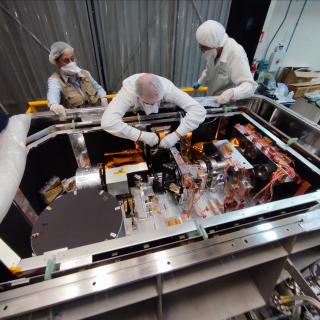

During October, the Adaptive Optics System team at the Gran Telescopio Canarias (GTCAO) of the Instituto de Astrofísica de Canarias (IAC), in collaboration with the technical team at the Gran Telescopio Canarias (GTC or Grantecan), successfully completed the integration of the GRANCAIN instrument into the world's largest optical-infrared telescope. The installation was carried out at the GTCAO outlet on the telescope's Nasmyth B platform, a key step in initiating performance testing of the new adaptive optics system.
This is the first scientific instrument to operate using the GTC's adaptive optics, a technology designed to compensate for the effects of atmospheric turbulence and obtain much sharper images.
‘Thanks to this combination, the telescope will be able to approach its maximum resolution limit, i.e., capture images with a quality comparable to that which it would offer from space,’ explains Marcos Reyes García-Talavera, head of the Instrumentation Area at the IAC.
GRANCAIN: a new window onto the infrared Universe
GRANCAIN (GRAN CÁmara INfrarroja) is an instrument that will observe in the near-infrared range, specifically in the J, H and K bands. Its objective is to obtain very high-resolution images in a field of 20 x 20 arc seconds, even in conditions of moderate atmospheric turbulence.
The instrument uses an advanced technology detector — a four-megapixel Hawaii-2 PACE sensor operated at extremely low temperatures (77 K, about –196 °C) — housed in an aluminium cryostat cooled by a helium system. This design minimises thermal noise and maximises sensitivity to the faint infrared light emitted by astronomical objects. GRANCAIN also incorporates two scientific filter wheels, with wide and narrow filters in the J, H and K bands, which allow the light to be studied to be selected with precision.
“Before the arrival of the FRIDA instrument, a state-of-the-art camera and integral field spectrograph, GRANCAIN will be essential for verifying the performance of GTCAO and beginning the first scientific observations with adaptive optics at the GTC,” says Reyes García-Talavera.
GTCAO: correcting the atmosphere to see further
The recently installed GTCAO system is an adaptive optics module designed to correct in real time the distortions that the Earth's atmosphere introduces into starlight. To do this, it uses a deformable mirror with 373 actuators, capable of changing shape hundreds of times per second, and a Shack-Hartmann wavefront sensor that analyses the effect of the atmosphere on the light reaching the telescope.
GTCAO represents a huge step forward in studying celestial objects in great detail: from regions where stars are born to distant galaxies and bodies in the Solar System. The system has been designed from the outset to be expandable in the future, incorporating a laser guide star, which will allow adaptive optics to be used anywhere in the sky, and a multi-conjugate configuration, which will greatly increase the size of the corrected sky field.
The Gran Telescopio Canarias: a unique infrastructure
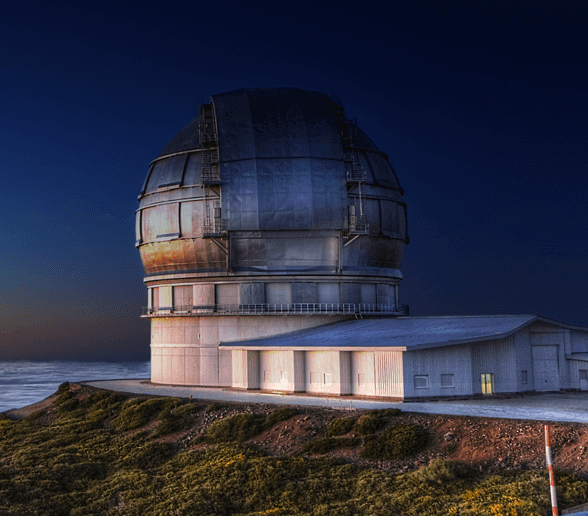
The Gran Telescopio Canarias (GTC), located at the Roque de los Muchachos Observatory (La Palma), is the largest optical and infrared telescope in the world. It belongs to the Spanish network of Singular Scientific and Technical Infrastructures (ICTS) and is funded by the Autonomous Community of the Canary Islands and the Spanish State, with the participation of institutions from Mexico and the United States.
Its advanced instrumentation places it at the forefront of international astronomical research, and the incorporation of adaptive optics with instruments such as GRANCAIN and FRIDA opens a new era in its ability to explore the Universe with unprecedented precision.
This project is funded by the Ministry of Science, Innovation and Universities from NextGenerationEU funds through the Spanish Government's Recovery, Transformation and Resilience Plan.