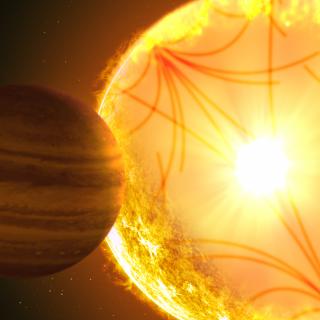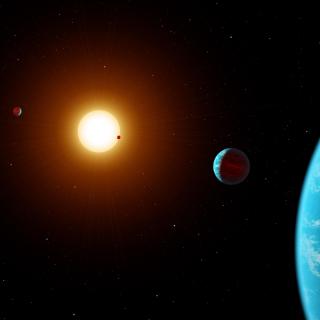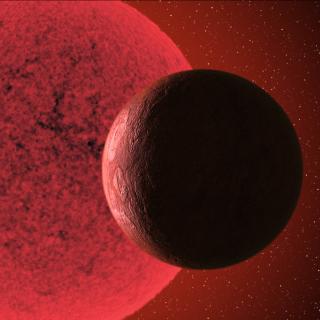

Artistic recreation of the planetary system HD 176986. Crédito: Gabriel Pérez Díaz (IAC)
An international scientific team led by the Instituto de Astrofísica de Canarias (IAC) has identified a new super-Earth orbiting the star HD 176986, a K-type dwarf located about 91 light-years away. The finding, published in the journal Astronomy and Astrophysics, brings the number of known planets in this system to three and confirms the value of long-term observation campaigns for detecting small, wide-orbiting worlds.
The observation campaign of HD 176986, an orange dwarf star or K-type star, slightly smaller than the Sun and located about 91 light-years away, has highlighted the importance of long-term monitoring of this type of target. This star has been known to host planets since 2018, when a scientific analysis led by Alejandro Suárez Mascareño, a researcher at the Instituto de Astrofísica de Canarias and co-author of the new study, discovered two planets orbiting it with periods of 6.5 and 16.8 days, named HD 176986 b and HD 176986 c, respectively.
“We continued to observe the star for years with cutting-edge instruments, and it was rewarding when the signal of a third planet came out once we joined together all the observations”, states Nicola Nari, first author of the study recently published in Astronomy and Astrophysics and current PhD student at the IAC with a scholarship funded by Light Bridges S.L.
A planetary system that continues to reveal surprises
The new planet, HD176986 d, has a minimum mass of 6.8 times that of Earth. This mass is between the masses of the two other planets in the system: the planet closest to the star, with a minimum mass five times that of Earth, and the planet on a 16.8 d orbit, which has a mass of about ten times the mass of our planet.
HD176986 d completes one revolution around its star every 61.4 days, following a wider orbit than the inner planets. Due to its mass, it is classified as a so-called super-Earth, a type of planet that is more massive than Earth but considerably smaller than gas giants.
We know only a dozen planets with orbital periods longer than 50 days and masses less than seven times that of Earth. These types of worlds are particularly difficult to detect. The main reason is that small planets far from their star produce very weak signals, requiring a large number of observations and prolonged monitoring to be reliably identified, as has been the case with HD 176986 d.
“There are not many super-Earths detected around K-dwarfs with orbital periods longer than 50 d, only dedicated long-survey can resolve their wide orbit and low-amplitude signals”, says Alejandro Suarez Mascareño, second author of the article and IAC researcher. “We kept observing the target, and at the end the signal came out”, adds Jonay I. Gonzalez Hernandez, head of research at the IAC and co-author of this work.
Technology and observations for detecting weak signals
One of the most complex tasks to detect a new planet is to determine if the signal found in the data has a planetary nature or if it is related to stellar activity. “We performed different tests to exclude an origin related to stellar activity. The planet passed all of them”, explains Atanas K. Stefanov, PhD student at the IAC and co-author of the article.
Detection was also aided by the use of innovative techniques that allow spectra—the light data from the star—to be refined and the effects of stellar activity and possible instrument imperfections to be better separated. This advance was made possible by the YARARA analysis tool. “YARARA corrects for sources of noise that can mimic or hide a planetary signal and invalidate the research of the fainter signals”, states Michael Cretignier, post-doctoral researcher at the University of Oxford, developer of YARARA, and co-author of the work. “The signal was still there after the correction of YARARA, this strengthened the confidence in the detection", comments Xavier Dumusque, assistant professor at Université de Genéve and co-author of this work.
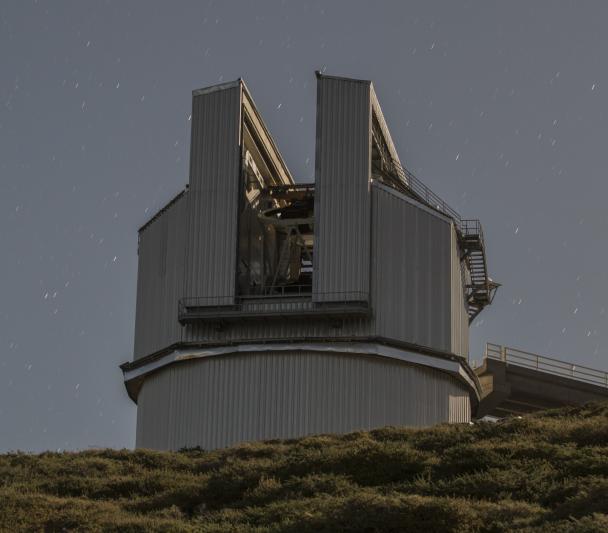
The planet was discovered with the radial velocity (RV) method, which measures the movement of the star induced by the gravitational attraction of the planets orbiting around it. More than 350 nights of observations were collected with HARPS, ESPRESSO, and HARPS-N spectrographs. HARPS and ESPRESSO are installed in Chile, at the 3.6 m telescope at the Observatory of La Silla and at the VLT telescope at the Observatory of Paranal respectively, while HARPS-N is installed at the Telescopio Nazionale Galileo at the Roque de los Muchachos Observatory on La Palma. “Our facilities for observations in La Palma proved to be fundamental for new scientific discoveries once more”, affirms Rafael Rebolo Lopez, researcher at the IAC and co-author of this article.
Article: Nicola Nari et al. "The RoPES project with HARPS and HARPS-N II. A third planet in the multi-planet system HD 176986", A&A, 705, A252 (2026). DOI: https://doi.org/10.1051/0004-6361/202557287
Contact at the IAC:
Nicola Nari (in English), nicola.nari [at] lightbridges.es (nicola[dot]nari[at]lightbridges[dot]es)
Alejandro Suarez Mascareño, alejandro.suarez.mascareno [at] iac.es (alejandro[dot]suarez[dot]mascareno[at]iac[dot]es)