
Bibcode
Yu, H.; Garai, Z.; Cretignier, M.; Szabó, Gy M.; Aigrain, S.; Gandolfi, D.; Bryant, E. M.; Correia, A. C. M.; Klein, B.; Brandeker, A.; Owen, J. E.; Günther, M. N.; Winn, J. N.; Heitzmann, A.; Cegla, H. M.; Wilson, T. G.; Gill, S.; Kriskovics, L.; Barragán, O.; Boldog, A.; Nielsen, L. D.; Billot, N.; Lafarga, M.; Meech, A.; Alibert, Y.; Alonso, R.; Bárczy, T.; Barrado, D.; Barros, S. C. C.; Baumjohann, W.; Bayliss, D.; Benz, W.; Bergomi, M.; Borsato, L.; Broeg, C.; Cameron, A. Collier; Csizmadia, Sz; Cubillos, P. E.; Davies, M. B.; Deleuil, M.; Deline, A.; Demangeon, O. D. S.; Demory, B. -O.; Derekas, A.; Doyle, L.; Edwards, B.; Egger, J. A.; Ehrenreich, D.; Erikson, A.; Fortier, A.; Fossati, L.; Fridlund, M.; Gazeas, K.; Gillon, M.; Güdel, M.; Helling, Ch; Isaak, K. G.; Kiss, L. L.; Korth, J.; Lam, K. W. F.; Laskar, J.; Lecavelier des Etangs, A.; Lendl, M.; Magrin, D.; Maxted, P. F. L.; McCormac, J.; Merín, B.; Mordasini, C.; Nascimbeni, V.; O'Brien, S. M.; Olofsson, G.; Ottensamer, R.; Pagano, I.; Pallé, E.; Peter, G.; Piazza, D.; Piotto, G.; Pollacco, D.; Queloz, D.; Ragazzoni, R.; Rando, N.; Rauer, H.; Ribas, I.; Santos, N. C.; Scandariato, G.; Ségransan, D.; Simon, A. E.; Smith, A. M. S.; Sousa, S. G.; Southworth, R.; Stalport, M.; Steinberger, M.; Sulis, S.; Udry, S.; Ulmer, B.; Ulmer-Moll, S.; Van Grootel, V.; Venturini, J.; Villaver, E.; Walton, N. A. et al.
Bibliographical reference
Monthly Notices of the Royal Astronomical Society
Advertised on:
1
2025
Citations
16
Refereed citations
16
Description
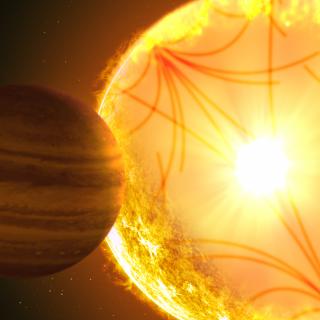
The AU Microscopii planetary system is only 24 Myr old, and its geometry may provide clues about the early dynamical history of planetary systems. Here, we present the first measurement of the Rossiter-McLaughlin effect for the warm sub-Neptune AU Mic c, using two transits observed simultaneously with the European Southern Observatory's (ESO's) Very Large Telescope (VLT)/Echelle SPectrograph for Rocky Exoplanets and Stable Spectroscopic Observations (ESPRESSO), CHaracterising ExOPlanet Satellite (CHEOPS), and Next-Generation Transit Survey (NGTS). After correcting for flares and for the magnetic activity of the host star, and accounting for transit-timing variations, we find the sky-projected spin-orbit angle of planet c to be in the range $\lambda _{\mathrm{c}}=67.8_{-49.0}^{+31.7}$ degrees (1$\sigma$). We examine the possibility that planet c is misaligned with respect to the orbit of the inner planet b ($\lambda _{\mathrm{b}}=-2.96_{-10.30}^{+10.44}$), and the equatorial plane of the host star, and discuss scenarios that could explain both this and the planet's high density, including secular interactions with other bodies in the system or a giant impact. We note that a significantly misaligned orbit for planet c is in some degree of tension with the dynamical stability of the system, and with the fact that we see both planets in transit, though these arguments alone do not preclude such an orbit. Further observations would be highly desirable to constrain the spin-orbit angle of planet c more precisely.
Related projects

Exoplanets and Astrobiology
The search for life in the universe has been driven by recent discoveries of planets around other stars (known as exoplanets), becoming one of the most active fields in modern astrophysics. The growing number of new exoplanets discovered in recent years and the recent advance on the study of their atmospheres are not only providing new valuable
Enric
Pallé Bago
Helio and Astero-Seismology and Exoplanets Search
The principal objectives of this project are: 1) to study the structure and dynamics of the solar interior, 2) to extend this study to other stars (either single or in binary systems), 3) to search for extrasolar planets using photometric methods (primarily by transits of their host stars) and their characterization with complementary radial
Savita
Mathur