
Bibcode
Barzaga, R.; García-Hernández, D. A.; Díaz-Tendero, S.; Sadjadi, SeyedAbdolreza; Manchado, A.; Alcami, M.
Bibliographical reference
The Astrophysical Journal
Advertised on:
1
2023
Journal
Citations
12
Refereed citations
12
Description
The presence of neutral C60 fullerenes in circumstellar environments has been firmly established by astronomical observations as well as laboratory experiments and quantum-chemistry calculations. However, the large variations observed in the C60 17.4 μm/18.9 μm band ratios indicate that either additional emitters should contribute to the astronomical infrared (IR) spectra or unknown physical processes exist besides thermal and UV excitation. Fullerene-based molecules such as metallofullerenes and fullerene-adducts are natural candidate species as potential additional emitters, but no specific specie has been identified to date. Here we report a model based on quantum-chemistry calculations and IR spectra simulation of neutral and charged endo(exo)hedral metallofullerenes, showing that they have a significant contribution to the four strongest IR bands commonly attributed to neutral C60. These simulations may explain the large range of 17.4 μm/18.9 μm band ratios observed in very different fullerene-rich circumstellar environments like those around planetary nebulae and chemically peculiar R Coronae Borealis stars. Our proposed model also reveals that the 17.4 μm/18.9 μm band ratio in the metallofullerenes simulated IR spectra mainly depends on the metal abundances, ionization level, and endo/exoconcentration in the circumstellar envelopes. We conclude that metallofullerenes are potential emitters contributing to the observed IR spectra in fullerene-rich circumstellar envelopes. Our simulated IR spectra indicate also that the James Webb Space Telescope has the potential to confirm or refute the presence of metallofullerenes (or even other fullerene-based species) in circumstellar environments.
Related projects
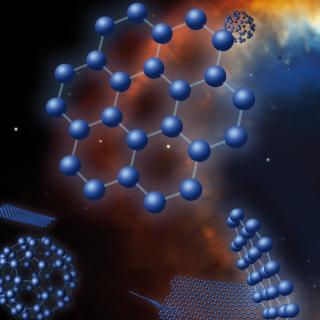
Nucleosynthesis and molecular processes in the late stages of Stellar Evolution
Low- to intermediate-mass (M < 8 solar masses, Ms) stars represent the majority of stars in the Cosmos. They finish their lives on the Asymptotic Giant Branch (AGB) - just before they form planetary nebulae (PNe) - where they experience complex nucleosynthetic and molecular processes. AGB stars are important contributors to the enrichment of the
Domingo Aníbal
García Hernández