
Bibcode
Han, Xiao; Wang, Hai-Feng; Carraro, Giovanni; López-Corredoira, Martín; Ting, Yuan-Sen; Luo, Yang-Ping; Wang, Guan-Yu; Mwludpsg Collaboration
Bibliographical reference
The Astrophysical Journal
Advertised on:
5
2025
Journal
Citations
8
Refereed citations
8
Description
We present an analysis of the structure, kinematics, and chemo-dynamical properties of the Milky Way bulge using RR Lyrae stars from Optical Gravitational Lensing Experiment (OGLE), and giant stars from APOGEE and Gaia that have distances placing them in the inner Galaxy. First, using a sample of 1879 ab-type RR Lyrae stars (RRabs) from OGLE-IV, we identified three populations: central bulge RRabs, the inner bulge RRabs, and halo or disk interlopers, based on their apocenters derived from orbital integration. Inner bulge RRabs kinematically align with the Galactic bar, while central bulge RRabs show slower rotation with lower velocity dispersion. Higher velocity dispersion stars were identified as halo/disk interlopers. Then, an orbital analysis of 28,188 APOGEE Red Clump and Red Giant Branch stars revealed kinematic properties consistent with RRabs, and the chemical abundance distribution displayed a bimodal stellar density pattern, suggesting complex star evolution histories and slightly different star formation histories for the inner bulge and central bulge. The differences in the density distribution on the ∣Z∣max-eccentricity plane for the central bulge, inner bulge, and interlopers are clearly detected. It is found that the classification of bulge stars based on orbital parameters, rather than solely on metallicity, provides a more accurate population separation. As the inner bulge, which contains the highest fraction of stars, traces the bar formed by the instability of the Galactic disk, our results support that the pseudobulge is the primary origin of the bulge. Furthermore, fitting the observed data to both the boxy and X-shaped bulge models indicated a preference for the boxy bulge.
Related projects
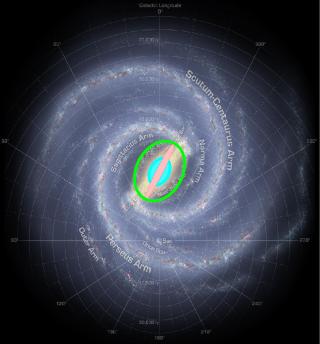
Milky Way and Nearby Galaxies
The overall aim of the project is to study the morphology, stellar populations, kinematics and dynamics (including formation and evolution) of the Milky Way and its satellite galaxies and other Local Group galaxies. The project can be divided into two main lines: I. Structure of the Milky Way and nearby galaxies. The detailed study of the
Martín
López Corredoira
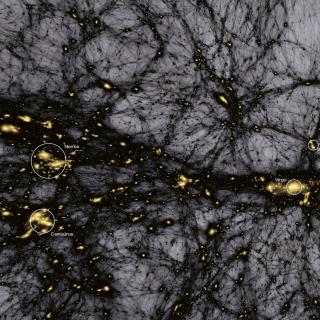
Cosmology with Large Scale Structure Probes
The Cosmic Microwave Background (CMB) contains the statistical information about the early seeds of the structure formation in our Universe. Its natural counterpart in the local universe is the distribution of galaxies that arises as a result of gravitational growth of those primordial and small density fluctuations. The characterization of the
Francisco Shu
Kitaura Joyanes