
Bibcode
Stefanov, A. K.; González Hernández, J. I.; Suárez Mascareño, A.; Nari, N.; Rebolo, R.; Damasso, M.; Castro-González, A.; Zapatero Osorio, M. -R.; Allende Prieto, C.; Silva, A. M.; Martins, C. J. A. P.
Bibliographical reference
Astronomy and Astrophysics
Advertised on:
1
2025
Journal
Citations
2
Refereed citations
2
Description
A sub-Earth-mass planet orbiting Barnard's star, designated as Barnard b, has recently been announced. At almost the same time, the first photometric data of Barnard's star by the Transit Exoplanet Survey Satellite (TESS) was released in Sector 80. We explore the possibility of emergent transits of Barnard b in TESS photometry. The detrended 2 min light curve appears to be flat, with a flux root mean square of 0.411 parts per thousand. Attempts of blind and informed transit curve model inference suggest no evidence of transiting Barnard b, or any other body. This provides a 3σ upper bound of 87.9 degrees for the orbital inclination of Barnard b.
Related projects
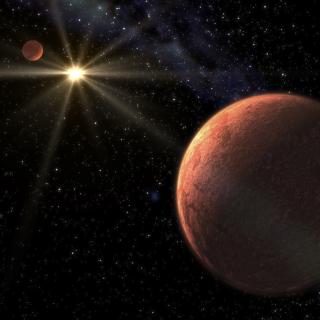
Very Low Mass Stars, Brown Dwarfs and Planets
Our goal is to study the processes that lead to the formation of low mass stars, brown dwarfs and planets and to characterize the physical properties of these objects in various evolutionary stages. Low mass stars and brown dwarfs are likely the most numerous type of objects in our Galaxy but due to their low intrinsic luminosity they are not so
Rafael
Rebolo López