Very Low Mass Stars, Brown Dwarfs and Planets

    General
    Description

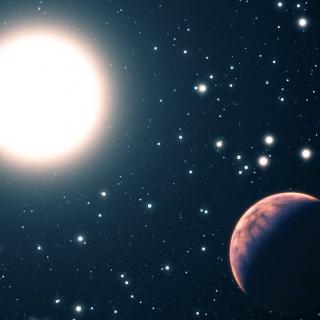
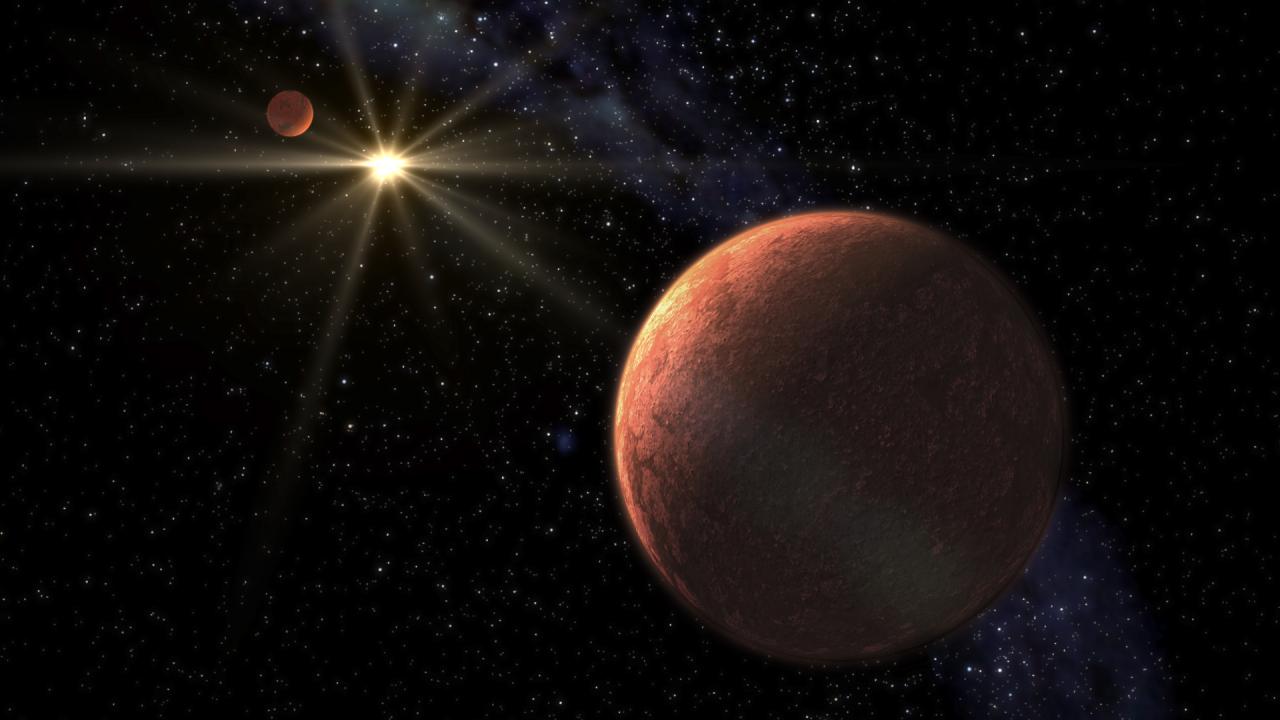
    Our goal is to study the processes that lead to the formation of low mass stars, brown dwarfs and planets and to characterize the physical properties of these objects in various evolutionary stages. Low mass stars and brown dwarfs are likely the most numerous type of objects in our Galaxy but due to their low intrinsic luminosity they are not so well known. We aim to study the frequency, multiplicity and spatial distribution of these objects in the solar neighbourhood and in nearby star forming regions and stellar clusters in order to better understand the mechanism of formation, characterise their optical and infrared properties and establish the relation between spectral properties, mass and luminosity.. Most of our effort will be dedicated to push toward lower mass limits the detection of these astros either bounded to stars and brown dwarfs and/or free-floating in interstellar space. The lowest mass objects display a lower intrinsic luminosity and cooler effective temperatures thus they are remarkably difficult to detect using direct imaging techniques. However, these techniques allow a full photometric and spectroscopic characterization and a best determination of their physical and chemical properties. We also aim to investigate the presence of planets around low mass stars using radial velocity measurements and techniques for high spatial resolution imaging. We will develop ultrastable spectrographs for large telescopes and systems for ultrafast imaging. With the spectrographs it would be possible to detect planets of similar mass to the Earth around G, K and M-type stars. The goal is to establish the frequency of these planets in stars of the solar neighbourhood and characterise the properties of the associated planetary systems.

    Principal investigator
    Project staff
    Nicola
    Nari
    1. Discovery of a sub-Earth planet (P=3.15d) with a minimum mass of 0.37 Mearth, i.e approximately three times the mass of Mars (and a possible candidate planetary system) orbiting Barnard's star (GJ699), using ESPRESSO observations 

    2. The lithium depletion boundary of the Hyades cluster.

    Related publications

    Stellar-activity analysis of the nearby M dwarf GJ 526: Multi-dimensional Gaussian-process modelling of RV, FWHM, and S-index 2025A&A...703A.245S
    Atmospheric composition and circulation of the ultra-hot Jupiter WASP-121b with joint NIRPS, HARPS and CRIRES+ transit spectroscopy 2025A&A...703A.251V
    TOI-283 b: A transiting mini-Neptune in a 17.6-day orbit discovered with TESS and ESPRESSO 2025A&A...703A.201M
    Observation of undepleted phosphine in the atmosphere of a low-temperature brown dwarf 2025Sci...390..697B
    A planetary system with a sub-Neptune planet in the habitable zone of TOI-2093 2025A&A...703A..93S
    A second low-mass planet orbiting the nearby M-dwarf GJ 536 2025A&A...702A.121S
    NIRPS and TESS reveal a peculiar system around the M dwarf TOI-756: A transiting sub-Neptune and a cold eccentric giant 2025A&A...702A.138P
    TOI-2322: Two transiting rocky planets close to the stellar rotation period and its first harmonic 2025A&A...702A..32H
    Quantifying thermal water dissociation in the dayside photosphere of WASP-121 b using NIRPS 2025A&A...701A.276B
    Silicate precursor silane detected in cold low-metallicity brown dwarf 2025Natur.645...62F
    Euclid Quick Data Release (Q1)—Spectroscopic Search, Classification, and Analysis of Ultracool Dwarfs in the Deep Fields 2025ApJ...991...84D
    The CARMENES search for exoplanets around M dwarfs: Revisiting the GJ 317, GJ463, and GJ 3512 systems and two newly discovered planets orbiting GJ9773 and GJ 508.2 2025A&A...700A.242M
    Polarized, variable radio emission from the scallop-shell binary system DG CVn 2025A&A...701A..69K
    Benchmark brown dwarfs – I. A blue M2 + T5 wide binary and a probable young [M4 + M4] + [T7 + T8] hierarchical quadruple 2025MNRAS.542..656Z
    The ESPRESSO transmission spectrum of HD189733 b: Extracting the planetary sodium and lithium signatures amid stellar contamination 2025A&A...700A..41M
    Two neighbours of the ultra-short-period Earth-sized planet K2-157 b in the warm Neptunian savanna 2025A&A...699A.344C
    A systematic bias in template-based radial velocity extraction algorithms 2025A&A...700A..93S
    Hydride ion continuum hides absorption signatures in the NIRPS near-infrared transmission spectrum of the ultra-hot gas giant WASP-189b 2025A&A...700A...9V
    A comprehensive study on radial velocity signals using ESPRESSO: Pushing precision to the 10 cm/s level 2025A&A...700A.174F
    Blind search for activity-sensitive lines in the near-infrared using HARPS and NIRPS observations of Proxima and Gl 581 2025A&A...700A.177G
    Diving into the planetary system of Proxima with NIRPS: Breaking the metre per second barrier in the infrared 2025A&A...700A..11S
    NIRPS detection of delayed atmospheric escape from the warm and misaligned Saturn-mass exoplanet WASP-69 b 2025A&A...700A...7A
    Discovery of a transiting hot water-world candidate orbiting Ross 176 with TESS and CARMENES 2025A&A...700A.216G
    NIRPS joining HARPS at ESO 3.6 m: On-sky performance and science objectives 2025A&A...700A..10B
    The ESPRESSO Redshift Drift Experiment: I. High-resolution spectra of the Lyman-α forest of QSO J052915.80-435152.0 2025A&A...699A.159T
    Optical constraints on the coldest metal-poor population 2025A&A...698A.141Z
    gr8stars – I. A homogeneous spectroscopic study of bright FGKM dwarfs and a public library of their high-resolution spectra 2025MNRAS.540.1786F
    The CARMENES search for exoplanets around M dwarfs: Cluster analysis of signals from spectral activity indicators to search for shared periods 2025A&A...697A.225K
    Ground-breaking exoplanet science with the ANDES spectrograph at the ELT 2025ExA....59...29P
    Detection of Methane in the Closest Extreme Metal-poor T Dwarf WISEA J181006.18‑101000.5 2025ApJ...984L..35Z
    Euclid: Early Release Observations – A glance at free-floating newborn planets in the σ Orionis cluster 2025A&A...697A...7M
    Euclid: I. Overview of the Euclid mission 2025A&A...697A...1E
    The PLATO mission 2025ExA....59...26R
    The CARMENES search for exoplanets around M dwarfs: Occurrence rates of Earth-like planets around very low-mass stars 2025A&A...696A.101K
    The CARMENES search for exoplanets around M dwarfs: Understanding the wavelength dependence of radial velocity measurements 2025A&A...696A..27J
    TOI-512: Super-Earth transiting a K-type star discovered by TESS and ESPRESSO 2025A&A...695A.237R
    HADES RV Programme with HARPS-N at TNG: XVI. A super-Earth in the habitable zone of the GJ 3998 multi-planet system 2025A&A...695A..62S
    The wide binary frequency of metal-poor stars 2025A&A...694A.129L
    Revisiting the multi-planetary system of the nearby star HD 20794: Confirmation of a low-mass planet in the habitable zone of a nearby G-dwarf 2025A&A...693A.297N
    CARMENES input catalogue of M dwarfs: IX. Multiplicity from close spectroscopic binaries to ultra-wide systems 2025A&A...693A.228C
    Related projects
    ARES: High Spectral Resolution
    ARES: High Spectral Resolution
    ARES (High Spectral Resolution) is a coordinated project which attempt to join and consolidate the efforts on instrument developments at high spectral resolution within the IAC. The goal is to launch the scientific programs that the IAC carries out on the search and characterization of exoplanets, in particular Earth-like exoplanets, on the
    Jonay Isaí
    González Hernández
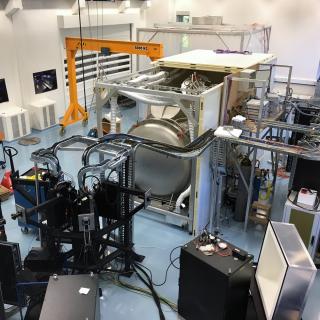
    Vista superior de ESPRESSO ya instalado
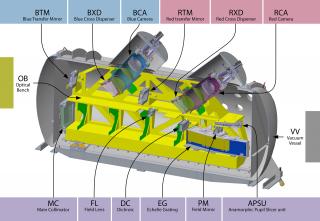
    ESPRESSO - Echelle Spectrograph for Rocky Exoplanet and Stable Spectroscopic Observation
    ESPRESSO is a fiber-fed, cross-dispersed, high resolution, Echelle spectrograph which can be operated with one or up to 4 Unit Telescopes (UTs) of ESO’s VLT.
    Rafael
    Rebolo López
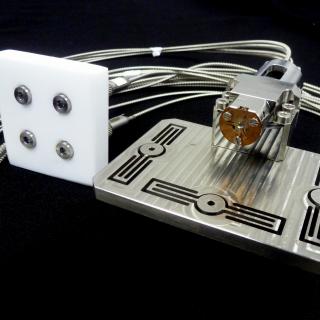
    Fiber link (brazo de fibras ópticas) de NIRPS
    NIRPS (Near Infra Red Planet Searcher)
    NIRPS is a next-generation, near-infrared spectrograph that uses adaptive optics and is fed via a fiber link. It is a compact cryogenic Echelle spectrograph, capable of operating alone or in combination with the HARPS instrument. It will have a spectral resolution of 100000 or 75000, and will be installed in La Silla observatory (Chile).
    Jonay Isaí
    González Hernández
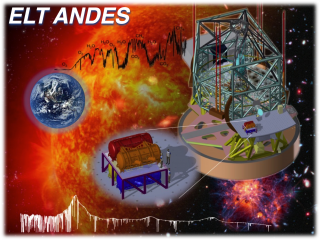
    Illustration of the ANDES instrument (formerly known as HIRES) and its adressed scientific goals. (Credit: HIRES consortium)
    ANDES - ArmazoNes high Dispersion Echelle Spectrograph
    ANDES (ArmazoNes high Dispersion Echelle Spectrograph) is an instrument under study for ESO’s forthcoming Extremely Large Telescope (ELT). The contract to begin design studies for ANDES, formerly known as HIRES, was signed in 2016 by ESO. IAC is one of the more than 30 institutions in the ANDES consortium.
    Rafael
    Rebolo López
    Jonay Isaí
    González Hernández
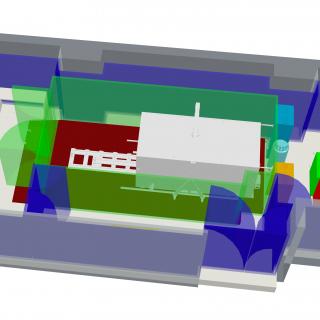
    Diseño 3D del instrumento en su ubicación
    HARPS3 (High Accuracy Radial velocity Planet Searcher)
    HARPS3 (High Accuracy Radial velocity Planet Searcher) is a new version of the succesful HARPS instrument. HARPS3 is an Echelle spectrograph with high resolution (R ~ 115000) and a wavelength range of 380-690 nm. It will be installed in the Isaac Newton Telescope (upgraded and robotized) at the ORM.
    Jonay Isaí
    González Hernández