
Researchers from the Instituto de Astrofísica de Canarias (IAC), in collaboration with the Instituto de Ciencias del Cosmos de la Universidad de Barcelona (ICCUB) and the Instituto de Estudios Espaciales de Cataluña (IEEC), have carried out the largest observational study to date on massive runaway stars including rotation and binarity in the Milky Way. This work, recently published in Astronomy & Astrophysics, sheds light on how these stellar “fugitives” are launched into space and what their properties reveal about their intriguing origins.
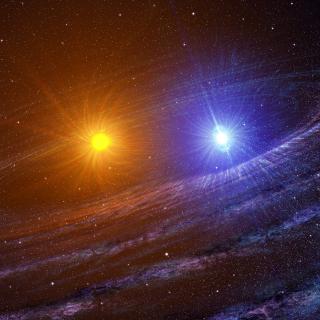
Runaway stars are stars that travel through space at unusually high speeds, moving away from the sites where they were born. The way that massive runaway stars acquired their high speeds have long puzzled astronomers that considered two scenarios: a powerful push when a companion explodes as a supernova in a binary system, or a gravitational ejection during close encounters in dense and young star clusters. However, the relative contribution of these scenarios to understand massive runaway stars were not well constrained in the Milky Way.
Using data from Gaia, a space observatory from the European Space Agency (ESA), together with high-quality spectroscopic observations from the IACOB project led at the Instituto de Astrofísica de Canarias (IAC), the team analyzed 214 O-type stars, which are the most massive and luminous stellar objects in the Galaxy. They combined measurements of rotation speed and binarity (whether the star is single or part of a binary system) for the largest sample of Galactic O-type runaway stars to understand their origins.
The results show that most runaway stars rotate slowly, but those that rotate faster are more likely linked to supernova explosions in binary systems. The fastest-moving stars tend to be single, suggesting they were ejected from young clusters through gravitational interactions. Interestingly, they found that there are almost no runaway stars that move fast and rotate fast, highlighting potential distinct formation pathways. The researchers also identified twelve runaway binary systems, including three known high-mass X-ray binaries (systems that host neutron stars or black holes), and three other binaries that are promising candidates to host black holes.
Massive runaway stars are not just curiosities, they influence the evolution of galaxies. By escaping their birthplaces, they spread heavy elements and radiation across the interstellar medium, shaping future generations of stars and planets. Understanding their origins helps refine models of stellar evolution, supernova explosions, and even the formation of gravitational wave sources. In this context, this work serves as a benchmark for the next generation of massive binary stellar evolution models and cluster dynamical studies.
“This is the most comprehensive observational study of its kind in the Milky Way,” says Mar Carretero-Castrillo, lead author of the study who is now based at the European Southern Observatory. “By combining rotation and binarity information, we provide the community with unprecedented constraints on how these stellar runaways form,” adds Sergio Simón-Díaz, researcher at the Instituto de Astrofísica de Canarias and leader of the IACOB project.
Future data releases from Gaia and ongoing spectroscopic surveys will allow astronomers to expand these samples and trace the past trajectories of runaway stars, linking them to their birth places. This will help confirm which formation mechanisms dominate and uncover new candidates for exotic systems like high-energy binaries hosting neutron stars or black hole companions.
Article: M. Carretero-Castrillo et al. "An observational study of rotation and binarity of Galactic O-type runaway stars". A&A, Volume 705, January 2026. DOI: https://doi.org/10.1051/0004-6361/202556646
Contact at the IAC:
Sergio Simón, sergio.simon.diaz [at] iac.es (sergio[dot]simon[dot]diaz[at]iac[dot]es)
Gonzalo Holgado, gonzalo.holgado [at] iac.es (gonzalo[dot]holgado[at]iac[dot]es)
Carlos Martínez, carlos.mtnez.sebastian [at] iac.es (carlos[dot]mtnez[dot]sebastian[at]iac[dot]es)