
The Planetary Society, the largest independent organization dedicated to space exploration—founded in 1980 by Carl Sagan, Bruce Murray, and Louis Friedman—has announced the award of its STEP (Science and Technology Empowered by the Public) Grants, a competitive program that funds innovative projects in science, technology, planetary defense, and the search for life. Among the three selected projects is AsteroiDB, an open platform for collecting, sharing, and analyzing photometric observations of asteroids. The project is led by Miguel R. Alarcón, Director of Scientific Operations at Light Bridges and predoctoral researcher at the Instituto de Astrofísica de Canarias (IAC), together with researchers Miquel Serra-Ricart (Light Bridges / IAC) and Javier Licandro (IAC).
A common platform for the photometric characterization of asteroids
Photometry makes it possible to study asteroids through the precise measurement of their brightness and how it changes over time and across different wavelengths. These variations, represented in what are known as light curves, contain information about some of their physical properties: how they rotate, what their shape is, what materials they are made of or, indirectly, what size they are. Photometric observations can be obtained with very different telescopes, from the most modest to those of largest aperture and, in many cases, it is necessary to combine measurements taken from different observatories and on different nights to obtain a complete characterization of the object.
While the measurements of asteroid positions in the sky have been centralized for decades at the Minor Planet Center (MPC) of the International Astronomical Union—the international reference for tracking these objects and computing their orbits—there is currently no equivalent platform that openly brings together the photometric observations used to characterize them. These observations are usually distributed across observatory archives, institutional databases, and the supplementary material of scientific papers. Moreover, existing catalogs tend to preserve the derived results—for example, rotation periods—but not necessarily the time series of measurements from which they were obtained. AsteroiDB aims to fill this gap by offering a common space where researchers can deposit, consult, combine, and share observations in a homogeneous and traceable way.
"AsteroiDB will allow researchers and observatories to deposit their series of measurements, share them, and analyze them jointly using tools developed by the community itself. This coordination is especially valuable in planetary defense, where characterizing a potentially hazardous object may require gathering, within a few days, observations from very diverse telescopes," explains Miguel R. Alarcón, the project's principal investigator.
“Observers around the world will be able to use the AsteroidDB tools to ease collaboration. They’ll be able to improve the speed and quality of how they study the physical properties of asteroids”, Bruce Betts, chief scientist at The Planetary Society, said.
Javier Licandro, researcher at the IAC and supervisor of Alarcón's doctoral thesis, notes that "the funding from The Planetary Society will make it possible to turn the prototype that Miguel has developed—and that the Solar System group has been using since 2024—into a public and open platform, with free access to the data and the possibility for observatories and researchers around the world to contribute their own observations." The platform will also feature tools for analyzing these data and obtaining scientific information about asteroids, the results of which can subsequently be used in scientific research and publications.
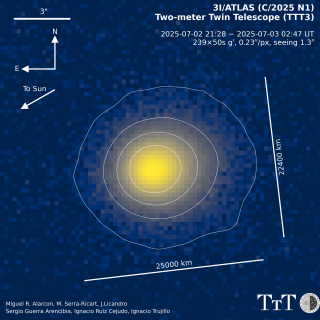
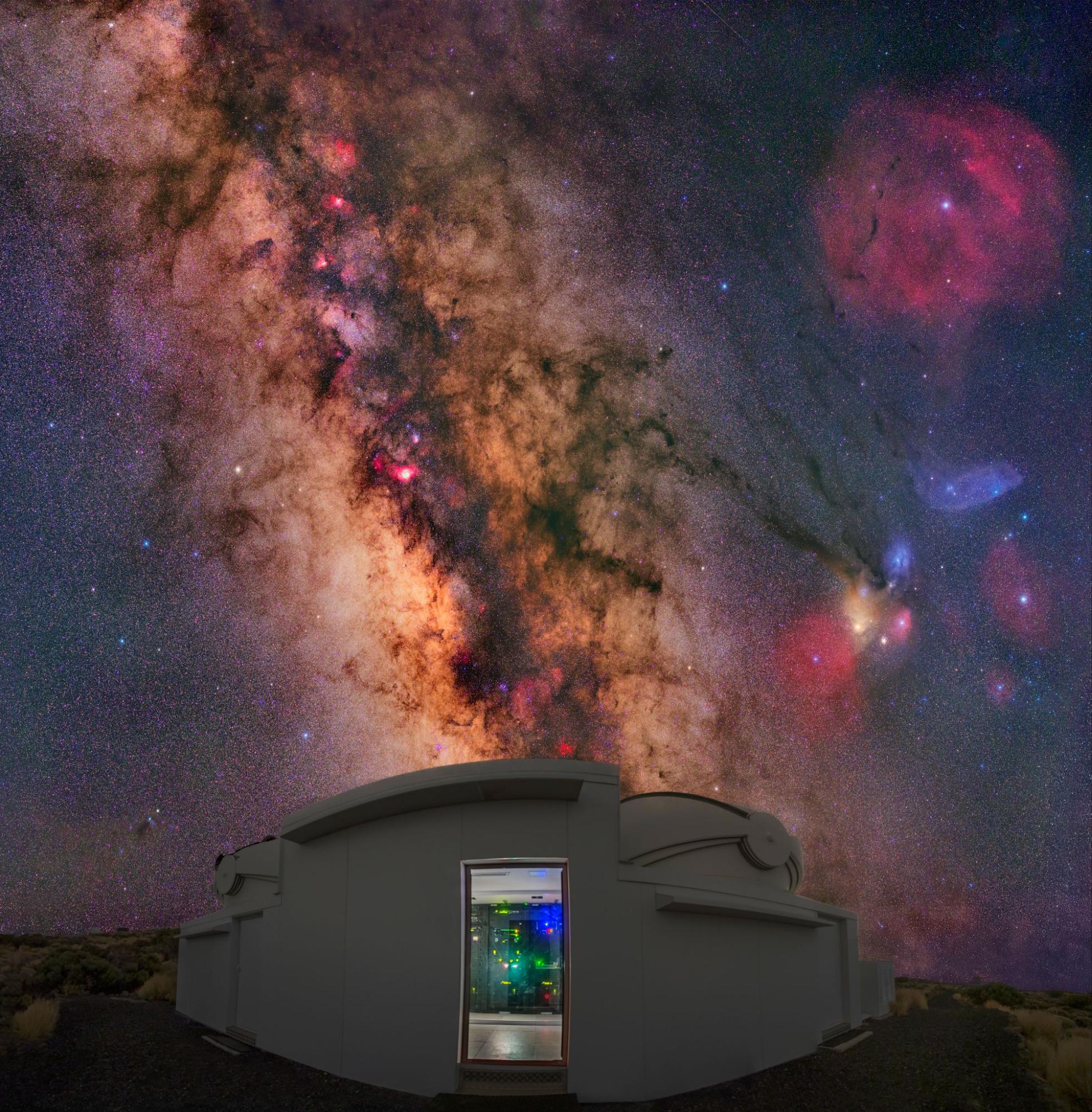
The project currently brings together observations obtained with the Two-meter Twin Telescope (TTT), the Transient Survey Telescope (TST), and ATLAS-Teide—an IAC facility integrated into the international ATLAS (Asteroid Terrestrial-impact Last Alert System) network for the detection and tracking of near-Earth objects. Together, these observations comprise more than 15 million measurements of over 500,000 different asteroids, which will be made available to the scientific community.
In the medium term, AsteroiDB aims to expand this collection with observations from other telescopes and to become a common tool for the photometric characterization of asteroids. In particular, it is expected to facilitate the coordination of photometric observations within the international planetary defense community, both in observing campaigns organized by the International Asteroid Warning Network (IAWN) and in response to the detection of a possible object at risk of impact. The project also seeks to help establish a common format for exchanging photometric observations of asteroids, enabling data obtained by different instruments to be combined and analyzed in a homogeneous way.
Advertisement from The Planetary Society
Contacto: Miguel R. Alarcon, mra [at] lightbridges.es (mra[at]lightbridges[dot]es)