Chemical Abundances in Stars

Start year
2010
Organizational Unit
    General
    Description

    Stellar spectroscopy allows us to determine the properties and chemical compositions of stars. From this information for stars of different ages in the Milky Way, it is possible to reconstruct the chemical evolution of the Galaxy, as well as the origin of the elements heavier than boron, created mainly in stellar interiors. It is also possible to study stellar formation, and the formation of the Galaxy, from the signature of the Galactic potential on the stellar orbits, and the distributions of mass, ages, and the abundance of heavy elements.

    Obtaining high-resolution spectra, as necessary for studies of chemical compositions, requires advanced and efficient instrumentation. This is particularly true for research that calls for large stellar samples, which demands the observation of hundreds or thousands of sources simultaneously. Efficiency requires that the data processing and analysis are performed in an automated way.

    The interpretation of spectra is based on physical models of the atmospheres of the stars, from where the light that we observe escapes the stars. The main ingredients for building such models are the fluid dynamics, and the properties of the atoms, ions, and molecules, especially regarding their interactions with the radiation coming from the stellar interior.

    Once we have a plausible model, it is possible to compute in detail how the radiation propagates through the stellar atmosphere, and the emergent spectrum, which can then be iteratively compared with the observations to refine the model.

    This project covers three different research fronts:

    - Improving model atmospheres and simulations of stellar spectra.

    - Developing tools for acquisition, reduction, and analysis of spectroscopic observations, in particular for the determination of chemical abundances in stars.

    - Designing, preparing, and executing spectroscopic studies of stars aimed at understanding a) the most relevant aspects of the physics of stellar atmospheres, b) the formation and evolution of stars, c) the origin of the chemical elements, and d) the formation, structure, and evolution of the Milky Way galaxy.

    Principal investigator
    Collaborators
    Dr.
    I. Hubeny
    Dr.
    B. Castanheira
    Dr.
    M. Kilic
    Dr.
    S. Majewski
    Dr.
    H.G. Ludwig
    Dr.
    M. Cropper
    Dr.
    M. P. Ruffoni
    Dr.
    J. C. Pickering
    Dr.
    K. Cunha
    Dr.
    Andrew Cooper
    Dr.
    Boris Gaensicke
    1. Complete the installation and commissioning of HORuS on GTC
    2. Discover two new stars with more than 100,000 times less iron than the Sun
    3. Complete the classification of all the APOGEE spectra with K-means
    4. Publish a complete collection of model stellar spectra for stars O to M
    5. Identify the signature of chemical diffusion in the atmospheres of the stars in the cluster M67

    Related publications

    Young [α/Fe]-enhanced stars discovered by CoRoT and APOGEE: What is their origin? 2015A&A...576L..12C
    X-Ray Evidence for a Pole-dominated Corona on AB Dor 2015ApJ...802...62D
    Gaia-ESO Survey: Analysis of pre-main sequence stellar spectra 2015A&A...576A..80L
    The APOGEE Spectroscopic Survey of Kepler Planet Hosts: Feasibility, Efficiency, and First Results 2015AJ....149..143F
    The Puzzling Li-Rich Red Giant Associated With Ngc 6819 2015ApJ...802....7C
    The Gaia-ESO Survey: A globular cluster escapee in the Galactic halo 2015A&A...575L..12L
    The Gaia-ESO survey: Discovery of a spatially extended low-mass population in the Vela OB2 association 2015A&A...574L...7S
    The Gaia-ESO Survey: Kinematics of seven Galactic globular clusters 2015A&A...573A.115L
    Sodium and Oxygen Abundances in the Open Cluster NGC 6791 from APOGEE H-band Spectroscopy 2015ApJ...798L..41C
    Low-resolution optical spectra of ultracool dwarfs with OSIRIS/GTC 2015MNRAS.446.3878M
    The APOKASC Catalog: An Asteroseismic and Spectroscopic Joint Survey of Targets in the Kepler Fields 2014ApJS..215...19P
    The Gaia-ESO Survey: the chemical structure of the Galactic discs from the first internal data release 2014A&A...572A..33M
    Disk Survival in the Extremely Massive Association Cygnus OB2 2014ASSP...36...89G
    Tracing Chemical Evolution over the Extent of the Milky Way's Disk with APOGEE Red Clump Stars 2014ApJ...796...38N
    The Gaia-ESO Survey: the most metal-poor stars in the Galactic bulge 2014MNRAS.445.4241H
    The Gaia-ESO Survey: The analysis of high-resolution UVES spectra of FGK-type stars 2014A&A...570A.122S
    Bayesian distances and extinctions for giants observed by Kepler and APOGEE 2014MNRAS.445.2758R
    Accretion and Outflow in the Proplyd-like Objects Near Cygnus OB2 2014ApJ...793...56G
    A new gravitational wave verification source 2014MNRAS.444L...1K
    Deep SDSS optical spectroscopy of distant halo stars. I. Atmospheric parameters and stellar metallicity distribution 2014A&A...568A...7A
    The APOGEE Red-clump Catalog: Precise Distances, Velocities, and High-resolution Elemental Abundances over a Large Area of the Milky Way's Disk 2014ApJ...790..127B
    Ultra-short Period Binaries from the Catalina Surveys 2014ApJ...790..157D
    The Vertical Metallicity Gradient of the Milky Way Disk: Transitions in [α/Fe] Populations 2014ApJ...791..112S
    IPHAS and the symbiotic stars. III. New discoveries and their IR spectral energy distributions 2014A&A...567A..49R
    The Gaia-ESO Survey: the Galactic thick to thin disc transition 2014A&A...567A...5R
    The Catalina Surveys Periodic Variable Star Catalog 2014ApJS..213....9D
    Extinction Maps toward the Milky Way Bulge: Two-dimensional and Three-dimensional Tests with APOGEE 2014AJ....148...24S
    The planetary nebula IPHASXJ211420.0+434136 (Ou5): insights into common-envelope dynamical and chemical evolution 2014MNRAS.441.2799C
    The Gaia-ESO Survey: processing FLAMES-UVES spectra 2014A&A...565A.113S
    Chemodynamics of the Milky Way. I. The first year of APOGEE data 2014A&A...564A.115A
    The Gaia-ESO Survey: radial metallicity gradients and age-metallicity relation of stars in the Milky Way disk 2014A&A...565A..89B
    Chemical Cartography with APOGEE: Large-scale Mean Metallicity Maps of the Milky Way Disk 2014AJ....147..116H
    The SEGUE K Giant Survey. II. A Catalog of Distance Determinations for the SEGUE K Giants in the Galactic Halo 2014ApJ...784..170X
    Discovery of Two Rare Rigidly Rotating Magnetosphere Stars in the APOGEE Survey 2014ApJ...784L..30E
    The Tenth Data Release of the Sloan Digital Sky Survey: First Spectroscopic Data from the SDSS-III Apache Point Observatory Galactic Evolution Experiment 2014ApJS..211...17A
    ESPRESSO: The next European exoplanet hunter 2014AN....335....8P
    Identification of red supergiants in nearby galaxies with mid-IR photometry 2014A&A...562A..75B
    New Red Jewels in Coma Berenices 2014ApJ...782...61T
    Doppler imaging of the double-lined active binary V824 Ara 2013AN....334..976K
    Hypervelocity Star Candidates in the SEGUE G and K Dwarf Sample 2014ApJ...780....7P
    Related projects
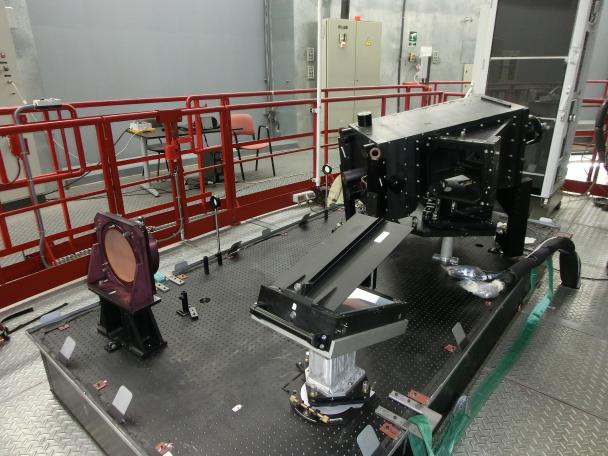
    Optical bench
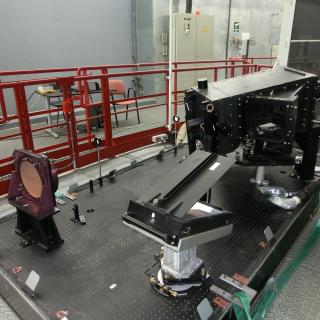
    HORuS - High Optical Resolution Spectrograph
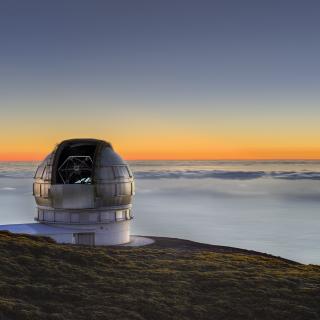
    High-resolution spectrograph for the 10-m Gran Telescopio Canarias (GTC) based on components from UES, a spectrograph which was in use at the 4.2-m William Herschel Telescope (WHT) between 1992 and 2001.
    Carlos
    Allende Prieto
    Gran Telescopio Canarias (GTC)
    SEVERO OCHOA 2016 - 2019
    The IAC is an internationalized Spanish research centre aiming to achieve major advances in the understanding of the laws that govern the origin and evolution of the various forms of matter/energy in the Universe. Outstanding results are expected in key areas of research such as Solar physics, Sun-Earth connections, Exoplanetary systems, Solar
    Rafael
    Rebolo López