
Small Bodies of the Solar System

    General
    Description

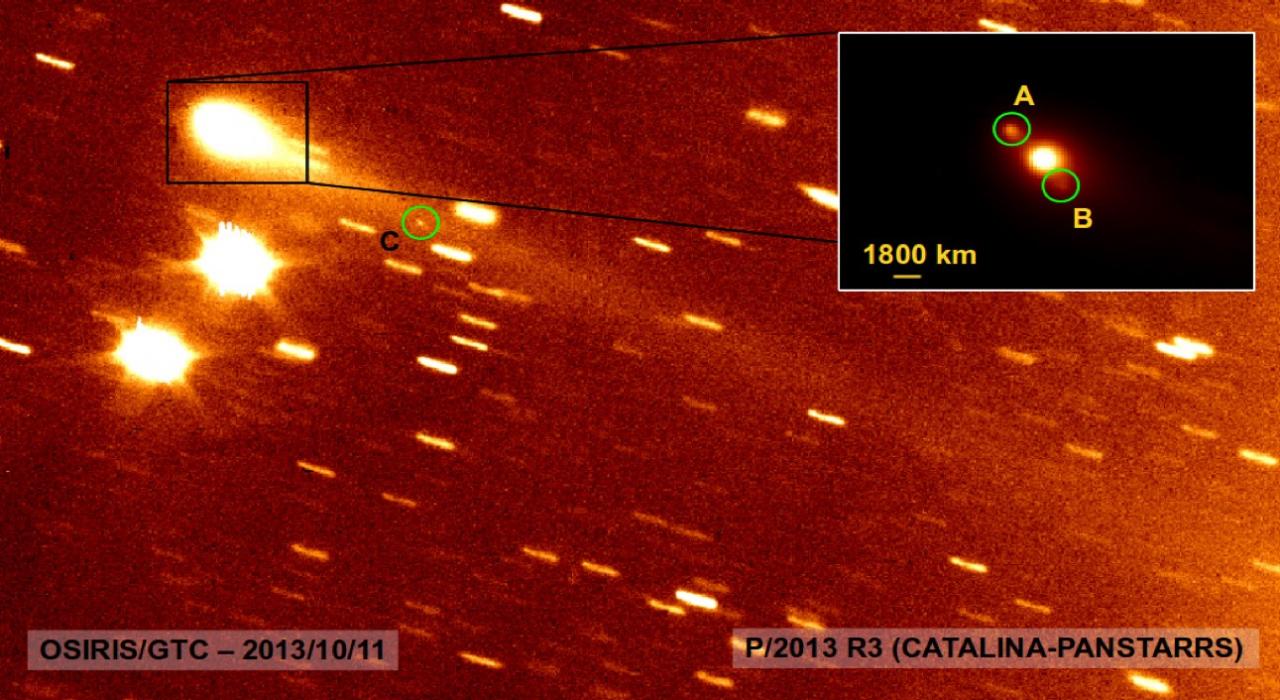
    This project studies the physical and compositional properties of the so-called minor bodies of the Solar System, that includes asteroids, icy objects, and comets. Of special interest are the trans-neptunian objects (TNOs), including those considered the most distant objects detected so far (Extreme-TNOs or ETNOs); the comets and the comet-asteroid transitional objects (Centaurs and main belt comets or MBCs); the primitive asteroids. The last two groups contain the most primordial and pristine material of the Solar System and so they provide the clues to understand the origin and the subsequent evolution of our system. Among asteroid population, the near-Earth asteroids or NEAs, as well as the potentially hazardous asteroids (PHAs) are of particular interest: due to their proximity to the Earth, they are the most accesible to spacecraft and so are ideal for in-situ or even sample-return space missions. In addition they are considered as future potential resources of materials (asteroid mining), and they are also impact hazards for the Earth. Regarding primitive asteroids, it is remarkable the spectroscopic survey (visible and near-infrared) led by the PI of this project (PRIMitive Asteroids Spectroscopic Survey - PRIMASS). This survey received financial support from NASA (17-PDART17_2-0097, PI: N. Pinilla-Alonso, 137.000€ - 2 years) in order to upload and archive at the Small Bodies Node of the NASA Planetary Data System the more than 800 spectra obtained.

    The compositional surface properties, as well as the physical and thermal properties of these objects are inferred through imaging, photometry, and spectroscopy in a wide range of wavelengths (from 0.35 up to 24 microns). Data are interpreted using scattering and thermo-physical models. This project works also in the study of the physical properties of the cometary nuclei, as well as properties of dust and coma in the tails of the MBCs and the mechanisms that generate them.

    This group maintains several international collaborations with other groups, and some of their members are also members of (1) the Science Team of the NASA OSIRIS-REx mission, in particular the Image Processing Working Group, were they work with the images obtained with the OCAMS suite of cameras; (2) the coordination of an international group to study NEAs (EURONEAR); (3) the central core of the proponents of ESA M5 missions CASTALIA, CASTAway, and Hera; (4) the Center for Lunar and Asteroid Surface Science - CLASS (NASA); (5) the Solar System group of the Euclid consortium; (6) the surveys J-PLUS and J-PASS for the exploitation of observations of Solar System objects; (7) the Solar System working group of Gaia and JWST.
    Principal investigator
    Project manager
    Collaborators
    Dr.
    Noemí Pinilla-Alonso
    Dr.
    Humberto Campins
    Dr.
    Fernando Moreno Danvila
    Dr.
    Y. Fernández
    Dr.
    José Luis Ortiz
    Dr.
    R. Duffard
    Prof.
    R. Hil-Hutton

    Related publications

    Visible and near-infrared observations of asteroid 2012 DA14 during its closest approach of February 15, 2013 2013A&A...555L...2D
    The persistent activity of Jupiter-family comets at 3–7 AU 2013Icar..225..475K
    Physical properties of B-type asteroids from WISE data 2013A&A...554A..71A
    The Dust Environment of Main-Belt Comet P/2012 T1 (PANSTARRS) 2013ApJ...770L..30M
    An evaluation of the exposure in nadir observation of the JEM-EUSO mission 2013APh....44...76A
    Near-infrared spectroscopy of 1999 JU3, the target of the Hayabusa 2 mission 2013A&A...552A..79P
    Activity of Comet 103P/Hartley 2 at the time of the EPOXI mission fly-by 2013Icar..222..766T
    Surface composition and dynamical evolution of two retrograde objects in the outer solar system: 2008 YB3 and 2005 VD 2013A&A...550A..13P
    Exploring the nature of new main-belt comets with the 10.4 m GTC telescope: (300163) 2006 VW139 2013A&A...550A..17L
    Albedo and atmospheric constraints of dwarf planet Makemake from a stellar occultation 2012Natur.491..566O
    A Short-duration Event as the Cause of Dust Ejection from Main-Belt Comet P/2012 F5 (Gibbs) 2012ApJ...761L..12M
    Asteroids (65) Cybele, (107) Camilla and (121) Hermione: Infrared spectral diversity among the Cybeles 2012Icar..221..453H
    Spectroscopic observations of new Oort cloud comet 2006 VZ13 and four other comets 2010MNRAS.401.2399G
    More than 160 near Earth asteroids observed in the EURONEAR network 2010A&A...511A..40B
    High-Precision Astrometry of NEAs via EURONEAR Observations 2010RoAJ...20S.119B
    Formation of asteroid pairs by rotational fission 2010Natur.466.1085P
    EURONEAR: Data mining of asteroids and Near Earth Asteroids 2009AN....330..698V
    Deep Ks -near-infrared Surface Photometry of 80 Dwarf Irregular Galaxies in the Local Volume 2010ApJ...716..792F
    A Pluto-like radius and a high albedo for the dwarf planet Eris from an occultation 2011Natur.478..493S
    Water ice and organics on the surface of the asteroid 24 Themis 2010Natur.464.1320C
    Visible spectroscopy in the neighborhood of 2003EL{61} 2008A&A...489..455P
    Triple F—a comet nucleus sample return mission 2009ExA....23..809K
    The trans-Neptunian object size distribution at small sizes 2009A&A...500..909G
    The surface of (136108) Haumea (2003 EL{61}), the largest carbon-depleted object in the trans-Neptunian belt 2009A&A...496..547P
    The spectrum of (136199) Eris between 350 and 2350 nm: results with X-Shooter 2011A&A...532A.130A
    The size and thermal properties of the nucleus of Comet 22P/Kopff 2009Icar..199..568G
    The Origin of Asteroid 101955 (1999 RQ36) 2010ApJ...721L..53C
    The activity of comet C/2007 D1 (LINEAR) at 9.7 AU from the Sun (Corrigendum) 2010A&A...524C...1M
    The activity of comet C/2007 D1 (LINEAR) at 9.7 AU from the Sun 2010A&A...513A..33M
    Testing the comet nature of main belt comets. The spectra of 133P/Elst-Pizarro and 176P/LINEAR 2011A&A...532A..65L
    Taxonomy of asteroids in the Cybele region from the analysis of the Sloan Digital Sky Survey colors 2010Icar..206..729G
    Structures in the dust coma of comet C/1999 T1 (McNaught-Hartley) from Jan. 26 to Feb. 05, 2001 2009A&A...497..843L
    Stardust-NExT, Deep Impact, and the accelerating spin of 9P/Tempel 1 2011Icar..213..345B
    Spitzer observations of the asteroid-comet transition object and potential spacecraft target 107P (4015) Wilson-Harrington 2009A&A...507.1667L
    Spitzer observations of spacecraft target 162173 (1999 JU3) 2009A&A...503L..17C
    Spectroscopy of B-type asteroids: Subgroups and meteorite analogs 2010JGRE..11506005C
    Spectral properties of asteroids in cometary orbits 2008A&A...481..861L
    Rotational fission of trans-Neptunian objects: the case of Haumea 2012MNRAS.419.2315O
    Physical properties and orbital stability of the Trojan asteroids 2008Icar..195..686M
    Origin of the near-Earth asteroid Phaethon and the Geminids meteor shower 2010A&A...513A..26D