
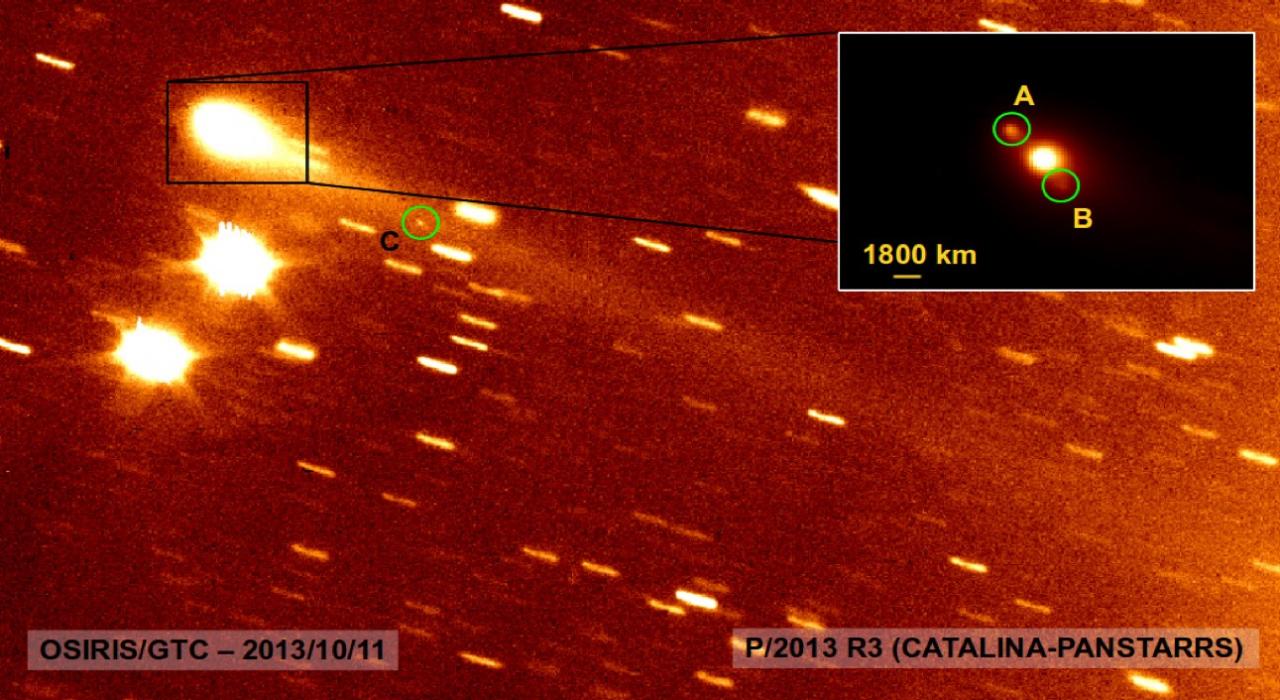
Small Bodies of the Solar System

    General
    Description

    This project studies the physical and compositional properties of the so-called minor bodies of the Solar System, that includes asteroids, icy objects, and comets. Of special interest are the trans-neptunian objects (TNOs), including those considered the most distant objects detected so far (Extreme-TNOs or ETNOs); the comets and the comet-asteroid transitional objects (Centaurs and main belt comets or MBCs); the primitive asteroids. The last two groups contain the most primordial and pristine material of the Solar System and so they provide the clues to understand the origin and the subsequent evolution of our system. Among asteroid population, the near-Earth asteroids or NEAs, as well as the potentially hazardous asteroids (PHAs) are of particular interest: due to their proximity to the Earth, they are the most accesible to spacecraft and so are ideal for in-situ or even sample-return space missions. In addition they are considered as future potential resources of materials (asteroid mining), and they are also impact hazards for the Earth. Regarding primitive asteroids, it is remarkable the spectroscopic survey (visible and near-infrared) led by the PI of this project (PRIMitive Asteroids Spectroscopic Survey - PRIMASS). This survey received financial support from NASA (17-PDART17_2-0097, PI: N. Pinilla-Alonso, 137.000€ - 2 years) in order to upload and archive at the Small Bodies Node of the NASA Planetary Data System the more than 800 spectra obtained.

    The compositional surface properties, as well as the physical and thermal properties of these objects are inferred through imaging, photometry, and spectroscopy in a wide range of wavelengths (from 0.35 up to 24 microns). Data are interpreted using scattering and thermo-physical models. This project works also in the study of the physical properties of the cometary nuclei, as well as properties of dust and coma in the tails of the MBCs and the mechanisms that generate them.

    This group maintains several international collaborations with other groups, and some of their members are also members of (1) the Science Team of the NASA OSIRIS-REx mission, in particular the Image Processing Working Group, were they work with the images obtained with the OCAMS suite of cameras; (2) the coordination of an international group to study NEAs (EURONEAR); (3) the central core of the proponents of ESA M5 missions CASTALIA, CASTAway, and Hera; (4) the Center for Lunar and Asteroid Surface Science - CLASS (NASA); (5) the Solar System group of the Euclid consortium; (6) the surveys J-PLUS and J-PASS for the exploitation of observations of Solar System objects; (7) the Solar System working group of Gaia and JWST.
    Principal investigator
    Project manager
    Collaborators
    Dr.
    Noemí Pinilla-Alonso
    Dr.
    Humberto Campins
    Dr.
    Fernando Moreno Danvila
    Dr.
    Y. Fernández
    Dr.
    José Luis Ortiz
    Dr.
    R. Duffard
    Prof.
    R. Hil-Hutton

    Related publications

    Meteor studies in the framework of the JEM-EUSO program 2017P&SS..143..245A
    V-type candidates and Vesta family asteroids in the Moving Objects VISTA (MOVIS) catalogue 2017A&A...600A.126L
    The 67P/Churyumov-Gerasimenko observation campaign in support of the Rosetta mission 2017RSPTA.37560249S
    Non-Vestoid candidate asteroids in the inner main belt 2017A&A...599A.107O
    The Splitting of Double-component Active Asteroid P/2016 J1 (PANSTARRS) 2017ApJ...837L...3M
    The Remote Observatories of the Southeastern Association for Research in Astronomy (SARA) 2017PASP..129a5002K
    The JEM-EUSO mission: An introduction 2015ExA....40....3A
    The JEM-EUSO instrument 2015ExA....40...19A
    The atmospheric monitoring system of the JEM-EUSO instrument 2015ExA....40...45A
    The infrared camera onboard JEM-EUSO 2015ExA....40...61A
    Calibration aspects of the JEM-EUSO mission 2015ExA....40...91A
    JEM-EUSO observational technique and exposure 2015ExA....40..117A
    The JEM-EUSO observation in cloudy conditions 2015ExA....40..135A
    Performances of JEM-EUSO: angular reconstruction. The JEM-EUSO Collaboration 2015ExA....40..153A
    Performances of JEM-EUSO: energy and X max reconstruction 2015ExA....40..183A
    Ultra high energy photons and neutrinos with JEM-EUSO 2015ExA....40..215A
    Science of atmospheric phenomena with JEM-EUSO 2015ExA....40..239A
    JEM-EUSO: Meteor and nuclearite observations 2015ExA....40..253A
    The EUSO-Balloon pathfinder 2015ExA....40..281A
    Ground-based tests of JEM-EUSO components at the Telescope Array site, "EUSO-TA" 2015ExA....40..301A
    Space experiment TUS on board the Lomonosov satellite as pathfinder of JEM-EUSO 2015ExA....40..315A
    The Rotation Period of C/2014 Q2 (Lovejoy) 2015ApJ...814...49S
    Physical properties of the extreme Centaur and super-comet candidate 2013 AZ60 2015A&A...583A..93P
    On the Dust Environment of Main-Belt Comet 313P/Gibbs 2015ApJ...806..102P
    Rotationally resolved spectroscopy of dwarf planet (136472) Makemake 2015A&A...577A..86L
    First EURONEAR NEA discoveries from La Palma using the INT 2015MNRAS.449.1614V
    Possible ring material around centaur (2060) Chiron 2015A&A...576A..18O
    The binary near-Earth Asteroid (175706) 1996 FG3 - An observational constraint on its orbital evolution 2015Icar..245...56S
    The infrared camera prototype characterization for the JEM-EUSO space mission 2014NIMPA.749...74M
    Blending the distinctions among groups of minor bodies: a portrait of the Centaur-comet "transition" object P/2010 C1 (Scotti) 2014A&A...565A..69M
    Rotationally resolved spectroscopy of (20000) Varuna in the near-infrared 2014A&A...562A..85L
    Intermittent Dust Mass Loss from Activated Asteroid P/2013 P5 (PANSTARRS) 2014ApJ...781..118M
    Observational results for eight long-period comets observed far from the Sun 2014A&A...561A...6M
    Thermophysical properties of near-Earth asteroid (341843) 2008 EV5 from WISE data 2014A&A...561A..45A
    Mining the ESO WFI and INT WFC archives for known Near Earth Asteroids. Mega-Precovery software 2013AN....334..718V
    Lightcurve, Color and Phase Function Photometry of the OSIRIS-REx Target Asteroid (101955) Bennu 2013Icar..226..663H
    Thermal properties, sizes, and size distribution of Jupiter-family cometary nuclei 2013Icar..226.1138F
    739 observed NEAs and new 2–4 m survey statistics within the EURONEAR network 2013P&SS...85..299V
    Additional spectra of asteroid 1996 FG3, backup target of the ESA MarcoPolo-R mission 2013A&A...556A..33D
    The Origin of Asteroid 162173 (1999 JU3) 2013AJ....146...26C