
Small Bodies of the Solar System

    General
    Description

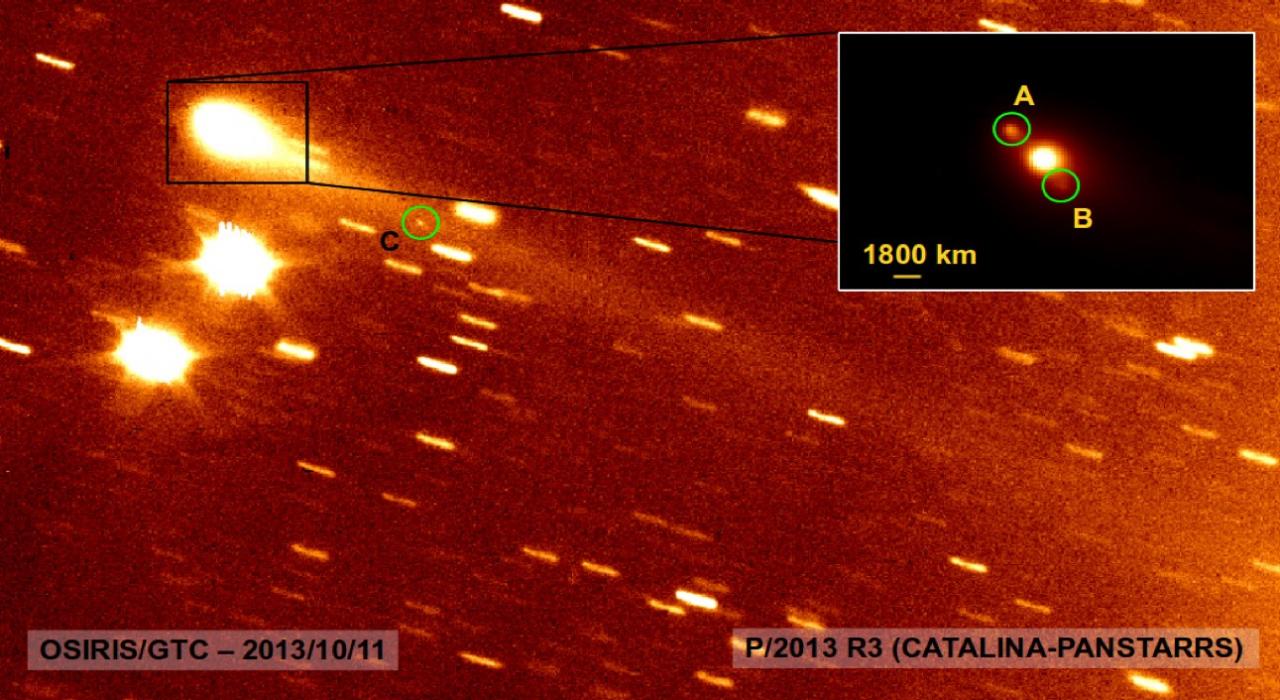
    This project studies the physical and compositional properties of the so-called minor bodies of the Solar System, that includes asteroids, icy objects, and comets. Of special interest are the trans-neptunian objects (TNOs), including those considered the most distant objects detected so far (Extreme-TNOs or ETNOs); the comets and the comet-asteroid transitional objects (Centaurs and main belt comets or MBCs); the primitive asteroids. The last two groups contain the most primordial and pristine material of the Solar System and so they provide the clues to understand the origin and the subsequent evolution of our system. Among asteroid population, the near-Earth asteroids or NEAs, as well as the potentially hazardous asteroids (PHAs) are of particular interest: due to their proximity to the Earth, they are the most accesible to spacecraft and so are ideal for in-situ or even sample-return space missions. In addition they are considered as future potential resources of materials (asteroid mining), and they are also impact hazards for the Earth. Regarding primitive asteroids, it is remarkable the spectroscopic survey (visible and near-infrared) led by the PI of this project (PRIMitive Asteroids Spectroscopic Survey - PRIMASS). This survey received financial support from NASA (17-PDART17_2-0097, PI: N. Pinilla-Alonso, 137.000€ - 2 years) in order to upload and archive at the Small Bodies Node of the NASA Planetary Data System the more than 800 spectra obtained.

    The compositional surface properties, as well as the physical and thermal properties of these objects are inferred through imaging, photometry, and spectroscopy in a wide range of wavelengths (from 0.35 up to 24 microns). Data are interpreted using scattering and thermo-physical models. This project works also in the study of the physical properties of the cometary nuclei, as well as properties of dust and coma in the tails of the MBCs and the mechanisms that generate them.

    This group maintains several international collaborations with other groups, and some of their members are also members of (1) the Science Team of the NASA OSIRIS-REx mission, in particular the Image Processing Working Group, were they work with the images obtained with the OCAMS suite of cameras; (2) the coordination of an international group to study NEAs (EURONEAR); (3) the central core of the proponents of ESA M5 missions CASTALIA, CASTAway, and Hera; (4) the Center for Lunar and Asteroid Surface Science - CLASS (NASA); (5) the Solar System group of the Euclid consortium; (6) the surveys J-PLUS and J-PASS for the exploitation of observations of Solar System objects; (7) the Solar System working group of Gaia and JWST.
    Principal investigator
    Project manager
    Project staff
    Collaborators
    Dr.
    Noemí Pinilla-Alonso
    Dr.
    Humberto Campins
    Dr.
    Fernando Moreno Danvila
    Dr.
    Y. Fernández
    Dr.
    José Luis Ortiz
    Dr.
    R. Duffard
    Prof.
    R. Hil-Hutton

    Related publications

    Displaying 281 - 298 of 298
    Observations, compositional, and physical characterization of near-Earth and Mars-crosser asteroids from a spectroscopic survey 2010A&A...517A..23D
    New observations of asteroid (175706) 1996 FG3, primary target of the ESA Marco Polo-R mission 2011A&A...530L..12D
    Near-infrared spectroscopy of primitive asteroid families 2011Icar..213..538Z
    Near-infrared spectroscopic survey of B-type asteroids: Compositional analysis 2012Icar..218..196D
    MarcoPolo-R near earth asteroid sample return mission 2012ExA....33..645B
    Low Perihelion Near-Earth Asteroids 2009EM&P..105..159C
    Links between the dynamical evolution and the surface color of the Centaurs 2012A&A...539A.144M
    Lightcurves of 6 Jupiter Trojan asteroids 2010P&SS...58.1035M
    Evolution of the dust coma in comet 67P/Churyumov-Gerasimenko before the 2009 perihelion 2011A&A...531A..54T
    EURONEAR—Recovery, follow-up and discovery of NEAs and MBAs using large field 1-2 m telescopes 2011P&SS...59.1632V
    EPOXI: Comet 103P/Hartley 2 Observations from a Worldwide Campaign 2011ApJ...734L...1M
    Digging into the surface of the icy dwarf planet Eris 2009Icar..199..520A
    Deep Impact, Stardust-NExT and the behavior of Comet 9P/Tempel 1 from 1997 to 2010 2011Icar..213..323M
    (65) Cybele: detection of small silicate grains, water-ice, and organics 2011A&A...525A..34L
    Water-ice-driven Activity on Main-Belt Comet P/2010 A2 (LINEAR)? 2010ApJ...718L.132M
    The Dust Environment of Main-Belt Comet P/2010 R2 (La Sagra) 2011ApJ...738L..16M
    5-14 μm Spitzer spectra of Themis family asteroids 2012A&A...537A..73L
    (596) Scheila in Outburst: A Probable Collision Event in the Main Asteroid Belt 2011ApJ...738..130M
    Displaying 1 - 16 of 16
    A predoctoral researcher at the IAC receives a STEP Grant from The Planetary Society
    El telescopio del IAC ATLAS-Teide descubre un asteroide de 10 metros de diámetro que pasó ‘rozando’ la Tierra el 12 de agosto
    An asteroid has been named with after IAC researcher Tania Le Pivert Jolivet
    The ULL and the IAC have created one of the largest photometric catalogues of asteroids observed in Spain
    The TTT telescope at the Teide Observatory detects the first periodic and wobbling jet in an interstellar comet
    Gran Telescopio Canarias observations confirm that Hayabusa2's asteroid target is smaller and faster than expected
    3I/ATLAS: The IAC is monitoring closely the third interstellar object detected in the Solar System
    Hera mission flies by Mars on its way to Didymos and captures unique images of its moons
    The IAC continues to track asteroid 2024 YR4 to refine the probability of impact in 2032
    The Solar System Group at the IAC discovers a new asteroid near the Earth
    Astronomers confirm a new “Trojan” asteroid that shares an orbit with Mars
    The IAC hosts the meeting of the NEOMIR mission that will boost the early detection of asteroids.
    Astronomers make a significant advance in our knowledge of the asteroids nearest to the Earth, the Arjunas
    Nailing Bennu's colors to the mast: new findings on the origin of this primitive body
    Exogeneous material found on the surface of asteroids Ryugu and Bennu
    The Gran Telescopio Canarias obtains the visible spectrum of C/2019 Q4 (Borisov), the first confirmed interstellar comet