
Pequeños Cuerpos del Sistema Solar

    General
    Descripción

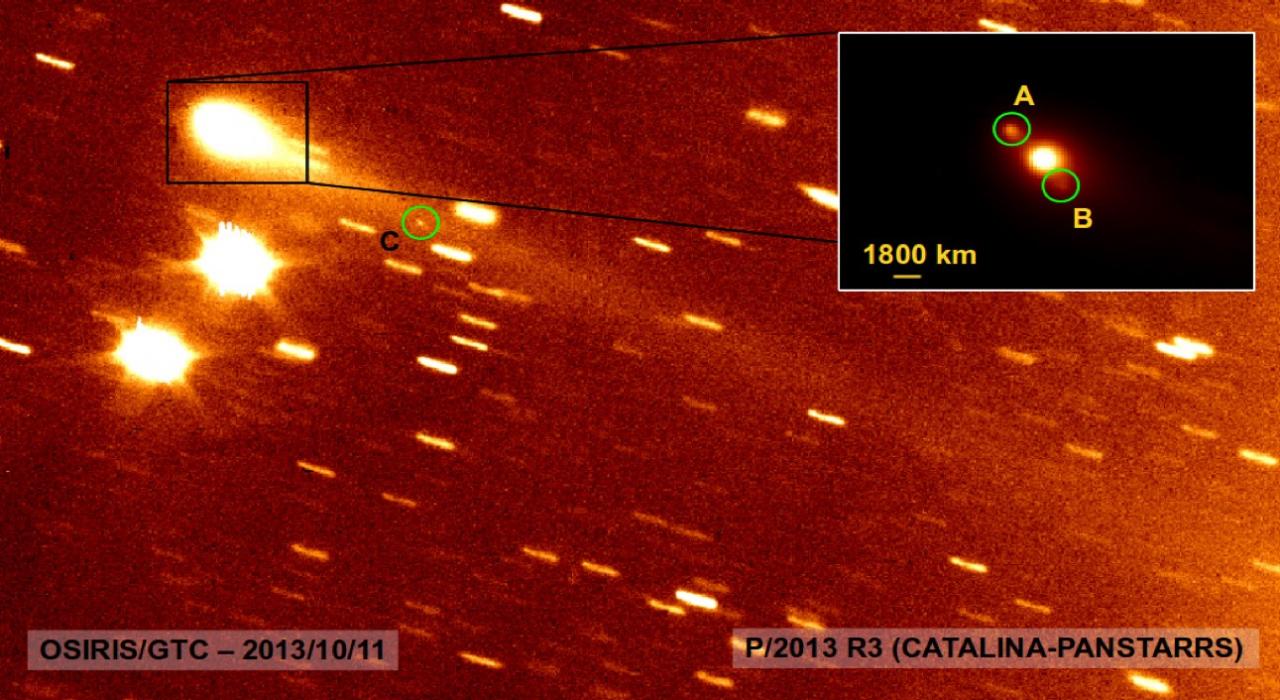
    Este Proyecto estudia las propiedades físicas y composicionales de los llamados pequeños cuerpos del Sistema Solar, que incluyen asteroides, objetos helados y cometas. Entre los grupos de mayor interés destacan los objetos trans-neptunianos (TNOs), incluyendo los objetos más lejanos detectados hasta la fecha (Extreme-TNOs o ETNOs); los cometas, y los objetos transicionales cometa-asteroide (Centauros y los llamados Main Belt Comets - MBCs); los asteroides primitivos. Los dos últimos grupos contienen el material más primordial y prístino del Sistema Solar son claves para comprender su origen y evolución. Se destacan entre los asteroides aquellos que se acercan a la órbita de la Tierra (near-Earth asteroids o NEAs), así como los considerados potencialmente peligrosos (Potentially Hazardous Asteroids o PHAs). Debido a su cercanía, los NEAs son los objetos más accesibles al estudio in-situ con misiones espaciales y su futura explotación como fuente de materias primas (asteroid mining). Se destaca el liderazgo por parte del IP del grupo de un survey espectroscópico (visible e infrarrojo cercano) de asteroids primitivos (PRIMitive Asteroid Spectroscopic Survey - PRIMASS). Este proyecto ha recibido financiación de la NASA (17-PDART17_2-0097, IP: N. Pinilla-Alonso, 137.000€ - 2 años) para archivar todos estos espectros (más de 800) en el Small Bodies Node del NASA Planetary Data System.

    Los estudios de composición superficial y propiedades físicas y térmicas de estos cuerpos se llevan a cabo utilizando espectroscopia en un amplio rango de longitudes de onda (desde 0.35 a 24 micras), así como imagen y fotometría en el mismo rango. Los datos se interpretan utilizando modelos de scattering y termo-físicos. El proyecto trabaja además en el análisis de las propiedades físicas de los núcleos cometarios y de las propiedades del polvo y el gas en las comas cometarias, muy especialmente en el estudio del polvo en las colas de los MBCs y de los mecanismos por los cuales se emite.

    Este grupo mantiene diversas colaboraciones internacionales con otros grupos entre las que podemos destacar: (1) la pertenencia al Grupo de Ciencia de la misión de NASA OSIRIS-REx, en concreto al "Image Processing Working Group", en donde se encarga del tratamiento de los mapas de color que se están obteniendo actualmente con las cámaras OCAMS; (2) la pertenencia al núcleo central de proponentes de las misiones M5 de ESA CASTALIA, CASTAway y Hera; (3) la coordinación de un grupo internacional de estudio de NEAs llamado EURONEAR (European Near Earth Asteroid Research); (4) la pertenencia al "Center for Lunar and Asteroid Surface Science" (CLASS, NASA); (5) la integración en el grupo de Sistema Solar de la misión Euclid; (6) la participación activa en los surveys J-PLUS y J-PASS, en los que trabaja en la explotación de las observaciones de objetos del Sistema Solar; (7) la pertenencia a los grupos de trabajo de Sistema Solar de los telescopios Gaia y JWST.

    Investigador principal
    Gestor del proyecto
    Personal del proyecto
    Colaboradores
    Dr.
    Noemí Pinilla-Alonso
    Dr.
    Humberto Campins
    Dr.
    Fernando Moreno Danvila
    Dr.
    Y. Fernández
    Dr.
    José Luis Ortiz
    Dr.
    R. Duffard
    Prof.
    R. Hil-Hutton

    Publicaciones relacionadas

    Deciding Technosignature Search Strategies: Multi-Criteria Fuzzy Logic to Find Extraterrestrial Intelligence 2024Aeros..11...88S
    Surface Heterogeneity, Physical, and Shape Model of Near-Earth Asteroid (52768) 1998 OR2 2024PSJ.....5...44D
    Measurement of D/H and <SUP>13</SUP>C/<SUP>12</SUP>C ratios in methane ice on Eris and Makemake: Evidence for internal activity 2024Icar..41115923G
    Orbit of the Patroclus–Menoetius Binary System and Predictions for the 2024/2025 Mutual Events Season 2024AJ....167..104B
    PRIMASS near-infrared study of the Erigone collisional family 2024Icar..41215973H
    Photometry of the Didymos System across the DART Impact Apparition 2024PSJ.....5...35M
    Spectroscopy of the binary TNO Mors-Somnus with the JWST and its relationship to the cold classical and plutino subpopulations observed in the DiSCo-TNO project 2024A&A...681L..17S
    Oort cloud perturbations as a source of hyperbolic Earth impactors 2024Icar..40815844P
    Improved models for the near-Earth asteroids (2100) Ra-Shalom, (3103) Eger, (12711) Tukmit, and (161989) Cacus 2024MNRAS.527.6814R
    When the horseshoe fits: Characterizing 2023 FY<SUB>3</SUB> with the 10.4 m Gran Telescopio Canarias and the Two-meter Twin Telescope 2024A&A...681A...4D
    The stellar occultation by (319) Leona on 2023 September 13 in preparation for the occultation of Betelgeuse 2024MNRAS.528L.139O
    Noble gases and nitrogen in samples of asteroid Ryugu record its volatile sources and recent surface evolution 2023Sci...379.0431O
    Soluble organic molecules in samples of the carbonaceous asteroid (162173) Ryugu 2023Sci...379.9033N
    Macromolecular organic matter in samples of the asteroid (162173) Ryugu 2023Sci...379.9057Y
    Near to Mid-infrared Spectroscopy of (65803) Didymos as Observed by JWST: Characterization Observations Supporting the Double Asteroid Redirection Test 2023PSJ.....4..214R
    Scaling slowly rotating asteroids with stellar occultations 2023A&A...679A..60M
    The Second International Asteroid Warning Network Timing Campaign: 2005 LW3 2023PSJ.....4..203F
    A review of planetary systems around HD 99492, HD 147379, and HD 190007 with HARPS-N 2023A&A...678A..90S
    The GAPS programme at TNG. XLVI. Deep search for low-mass planets in late-dwarf systems hosting cold Jupiters 2023A&A...677A.122P
    Heliocentric distance dependence of zodiacal light observed by Hayabusa2# 2023EP&S...75..121T
    Discovery and physical characterization as the first response to a potential asteroid collision: The case of 2023 DZ<SUB>2</SUB> 2023A&A...676A.126P
    Characterization of the Ejecta from the NASA/DART Impact on Dimorphos: Observations and Monte Carlo Models 2023PSJ.....4..138M
    Long-lasting activity of asteroid (248370) 2005 QN<SUB>173</SUB> 2023MNRAS.525..402I
    Borderline hyperbolic comet C/2021 O3 (PANSTARRS) was fading as it approached the Sun 2023MNRAS.524.2733E
    Deep K-band surface brightness photometry of dE galaxies. I. Local Volume and Virgo cluster 2023A&A...675A..90P
    Inflight calibration of the optical navigation camera for the extended mission phase of Hayabusa2 2023EP&S...75...36Y
    Physical properties of NEOs derived from their phase curves 2023MNRAS.523..739A
    Scientific CMOS Sensors in Astronomy: IMX455 and IMX411 2023PASP..135e5001A
    Hyades Member K2-136c: The Smallest Planet in an Open Cluster with a Precisely Measured Mass 2023AJ....165..235M
    The two rings of (50000) Quaoar 2023A&A...673L...4P
    Observations of two superfast rotator NEAs: 2021 NY<SUB>1</SUB> and 2022 AB 2023MNRAS.521.3784L
    Characterisation of the new target of the NASA Lucy mission: Asteroid 152830 Dinkinesh (1999 VD57) 2023A&A...672A.174D
    Near-ultraviolet absorption distribution of primitive asteroids from spectrophotometric surveys. I. Radial distribution 2023A&A...672A.189T
    Morphology and spectral properties of the DART impact ejecta with VLT/MUSE 2023A&A...671L..11O
    A dehydrated space-weathered skin cloaking the hydrated interior of Ryugu 2023NatAs...7..170N
    A Candidate Location for Planet Nine from an Interstellar Meteoroid: The Messenger Hypothesis 2023ApJ...945...22S
    Mini-moons from horseshoes: A physical characterization of 2022 NX<SUB>1</SUB> with OSIRIS at the 10.4 m Gran Telescopio Canarias 2023A&A...670L..10D
    Asteroids' reflectance from Gaia DR3: Artificial reddening at near-UV wavelengths 2023A&A...669L..14T
    First asteroid gas sample delivered by the Hayabusa2 mission: A treasure box from Ryugu 2022SciA....8O7239O
    A dehydrated space-weathered skin cloaking the hydrated interior of Ryugu