
Astrophysical research

The Milky Way and the Local Group (MWLG)
  • GhronoGal Logo
    Chronology of our Galaxy from Gaia Color-Magnitude Diagram fitting (GhronoGal)
    The overarching goal of ChronoGal is to unveil the sequence of events and physical processes that have shaped the Milky Way (MW) from its early assembly to the present, by providing the holy grail of Galactic Archaeology (GA): precise age information. Our Galaxy is key to study disk galaxy formation and evolution, as it can be analyzed in
    Carmen
    Gallart Gallart

  • Projets' image
    Physical properties and evolution of Massive Stars
    This project aims at the searching, observation and analysis of massive stars in nearby galaxies to provide a solid empirical ground to understand their physical properties as a function of those key parameters that gobern their evolution (i.e. mass, spin, metallicity, mass loss, and binary interaction). Massive stars are central objects to
    Sergio
    Simón Díaz
  • Project Image
    Morphology and dynamics of the Milky Way
    This project consists of two parts, each differentiated but both complementary: morphology and dynamics. Detailed study of the morphology of the Milky Way pretends to provide a data base for the stellar distribution in the most remote and heavily obscured regions of our Galaxy, through the development of semiempirical models based on the
    Martín
    López Corredoira
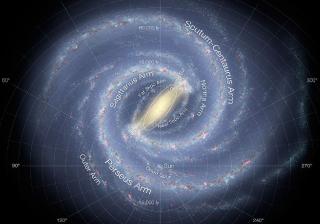
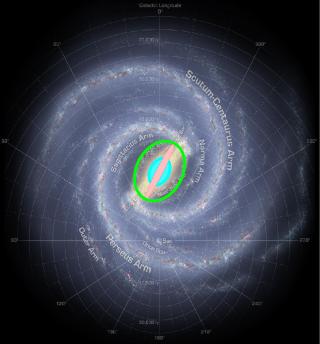
  • Superposition of model of long-bar+3-kpc arm of López-Corredoira et al. (2026, A&A 708, A288) with the artistic representation of the annotated ‘Road Map to the Milky Way’ by NASA/JPL-Caltech/R. Hurt (SSC/Caltech) based on NASA’s Spitzer Space Telescope achievements.
    Milky Way and Nearby Galaxies
    The overall aim of the project is to study the morphology, stellar populations, kinematics and dynamics (including formation and evolution) of the Milky Way and its satellite galaxies and other Local Group galaxies. The project can be divided into two main lines: I. Structure of the Milky Way and nearby galaxies. The detailed study of the
    Martín
    López Corredoira
  • Izquierda - Imagen RGB de la nebulosa de Orión y M43 obtenida filtros estrechos con la cámara WFC en el INT: H alfa (rojo), [S II] 6716+30 (verde), [O III] 5007 (azul). Derecha - Imagen en falso color de la nebulosa planetaria NGC 6778. En azul se ve la emisión en la línea de O II tomada con el filtro sintonizable azul del instrumento OSIRIS en el GTC; en verde imagen con el filtro estrecho de [O III] del Nordic Optical Telescope (NOT).
    Physics of Ionized Nebulae
    The research that is being carried out by the group can be condensed into two main lines: 1) Study of the structure, dynamics, physical conditions and chemical evolution of Galactic and extragalactic ionized nebulae through detailed analysis and modelization of their spectra. Investigation of chemical composition gradients along the disk of our
    Jorge
    García Rojas
  • Project Image
    Nucleosynthesis and molecular processes in the late stages of Stellar Evolution
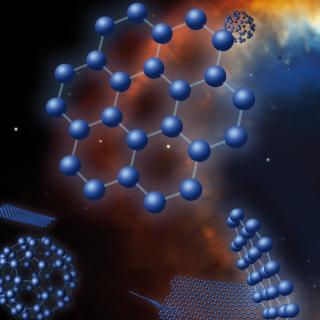
    Low- to intermediate-mass (M < 8 solar masses, Ms) stars represent the majority of stars in the Cosmos. They finish their lives on the Asymptotic Giant Branch (AGB) - just before they form planetary nebulae (PNe) - where they experience complex nucleosynthetic and molecular processes. AGB stars are important contributors to the enrichment of the
    Domingo Aníbal
    García Hernández