Helio and Astero-Seismology and Exoplanets Search

    General
    Description

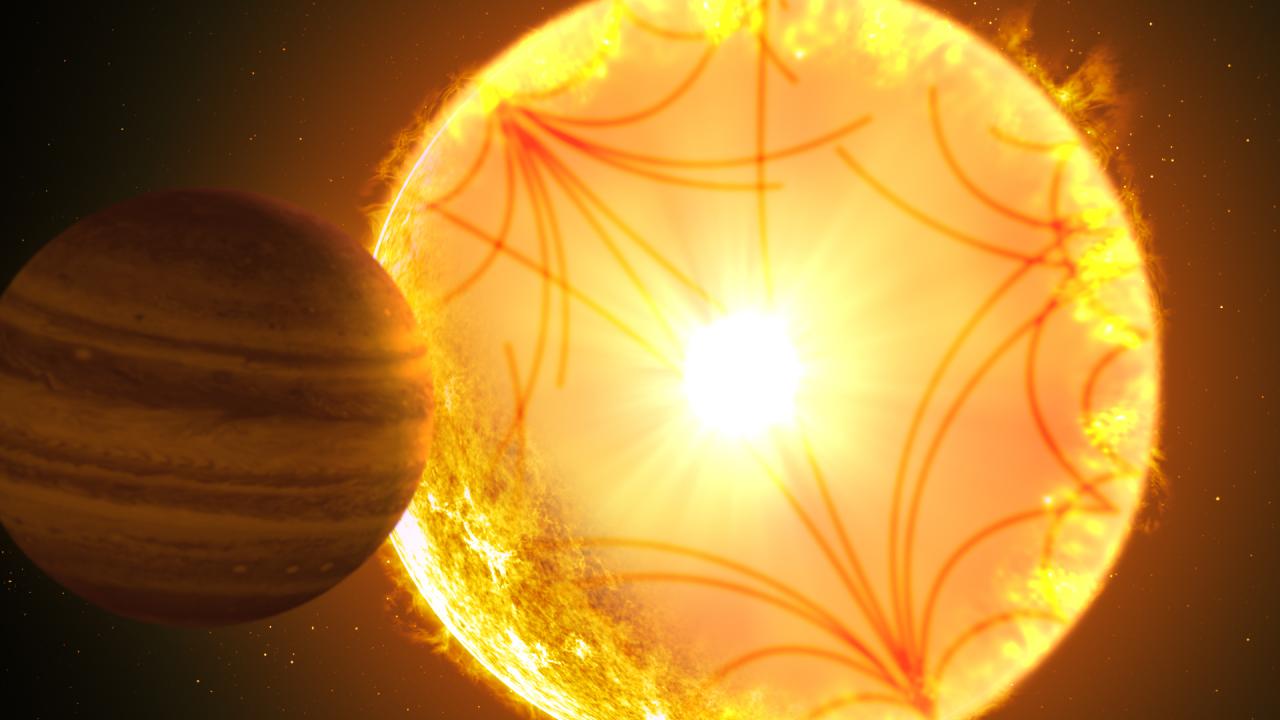
    The principal objectives of this project are: 1) to study the structure and dynamics of the solar interior, 2) to extend this study to other stars (either single or in binary systems), 3) to search for extrasolar planets using photometric methods (primarily by transits of their host stars) and their characterization with complementary radial velocity information.

    To reach our first objective, we use Helioseismology (analysis of the solar oscillation eigenmodes), a technique that enables us to infer the Sun's internal structure and dynamics with high accuracy. This project covers the various aspects necessary to attain the aforementioned objectives: instrumental and observational (with the international networks BiSON and GONG operating at the ”SolarLab” at Observatorio del Teide), reduction, analysis, and interpretation of data (in particular, the GOLF and VIRGO instruments aboard   ESA/SoHO satellite). Finally, theoretical developments in inversion techniques are carried out.

    Furthermore, Asteroseismology applies similar techniques to other oscillating stars to infer their evolutionary state as well as their internal structure and dynamics. Thanks to the high-quality photometric data collected by the CoRoT, Kepler, and TESS space missions, it is possible to extract global seismic parameters for hundreds of thousands of solar-like stars, from the main sequence through the red-giant phase. Stellar evolution models are used to find the model that best fits the observables (spectroscopic and individual mode frequencies), providing precise mass, radius, and age for the star. Binary stars provide additional strong constraints on these models and therefore allow testing the intricacies of internal stellar physics.

    Precise exoplanet characterization is critically dependent on an accurate knowledge of the host star. In particular, a reliable determination of the stellar age is required to constrain the age and evolutionary state of the planetary system, and to place robust limits on long-term habitability. At the interface between asteroseismology and exoplanet science, detailed seismic modeling of host stars is used to refine the ages of planetary systems. Strong involvement is ensured in the preparation of the ESA PLATO mission (launch expected at the end of 2026), including light-curve calibration, contributions to the science calibration and validation input catalog (scvPIC), proposals for complementary science, and ground-based follow-up observations.

    For this project, ground-based observations with the observational facilities available to IAC researchers, in particular at OCAN (Observatorios de Canarias), are key. In particular, ongoing observations with the ground-based, high-precision spectrographs on the SONG (Stellar Observations Network Group) and the Las Cumbres Observatory Network (LCO) are being conducted to improve the spectroscopic and seismic characterization of oscillating stars and to identify binary systems.

    Principal investigator

    Milestones

    1. Beck et al. (2024, A&A, 682, A7) increased the number of known solar-like oscillators in binary systems by about an order of magnitude. Such large sample allowed us to study the effects co-evolution of stellar evolution on the evolution of the binary orbits. Featured as "ESA Gaia image of the Week".
    2. Following the participation to the roadmaps in astrophysics for the ESA’s Human and Robotic Exploration Directorate in 2021, a paper in npj Microgravity was published where the key quetions in stellar physics were exposed along with proposed experiments for the future as part of that program (Mathur & Santos 2024).
    3. Merc et al. (2024, A&A, 683, A84) presented the first analysis of accretion-induced flickering variability in symbiotic binary stars from TESS lightcurves. This study significantly enlarged the known sample with such variability. This suggests that accretion disks are common in symbiotic stars.
    4. Solar magnetic activity in cycles 23&24 were analyzed by tracking GOLF low-degree p-mode frequency shifts across 3 bands, probing depths of 74–1575 km. Results suggest magnetic variations mainly occur near the surface. In cycle 24, shifts appeared earlier at high latitudes and coincided with surface activity near the equator, with stronger shifts at shallower depths.

    Related publications

    TOI-757 b: an eccentric transiting mini-Neptune on a 17.5-d orbit 2024MNRAS.533....1A
    CHEOPS in-flight performance. A comprehensive look at the first 3.5 yr of operations 2024A&A...687A.302F
    Detection of an Earth-sized exoplanet orbiting the nearby ultracool dwarf star SPECULOOS-3 2024NatAs...8..865G
    Gaia22dkvLb: A Microlensing Planet Potentially Accessible to Radial-velocity Characterization 2024AJ....168...62W
    Precise characterisation of HD 15337 with CHEOPS: A laboratory for planet formation and evolution 2024A&A...686A.282R
    HIP 41378 observed by CHEOPS: Where is planet d? 2024A&A...686L..18S
    Characterisation of the TOI-421 planetary system using CHEOPS, TESS, and archival radial velocity data 2024A&A...686A.301K
    Detailed cool star flare morphology with CHEOPS and TESS*** 2024A&A...686A.239B
    Kepler main-sequence solar-like stars: surface rotation and magnetic-activity evolution 2024FrASS..1156379S
    Magnetic activity of red giants: Correlation between the amplitude of solar-like oscillations and chromospheric indicators 2024A&A...686A..93G
    Discovery of a dormant 33 solar-mass black hole in pre-release Gaia astrometry 2024A&A...686L...2G
    Atmospheric Parameters and Abundances of Cool Red Giant Stars 2024PASP..136e4202D
    The tidal deformation and atmosphere of WASP-12 b from its phase curve★ 2024A&A...685A..63A
    Discovery of two warm mini-Neptunes with contrasting densities orbiting the young K3V star TOI-815 2024A&A...685A...5P
    The APO-K2 Catalog. II. Accurate Stellar Ages for Red Giant Branch Stars across the Milky Way 2024AJ....167..208W
    Nature versus nurture: distinguishing effects from stellar processing and chemical evolution on carbon and nitrogen in red giant stars 2024MNRAS.530..149R
    Asymmetry in the atmosphere of the ultra-hot Jupiter WASP-76 b 2024A&A...684A..27D
    Planets observed with CHEOPS. Two super-Earths orbiting the red dwarf star TOI-776 2024A&A...684A..12F
    Predicted asteroseismic detection yield for solar-like oscillating stars with PLATO 2024A&A...683A..78G
    Accretion-induced flickering variability among symbiotic stars from space photometry with NASA TESS 2024A&A...683A..84M
    TOI-544 b: a potential water-world inside the radius valley in a two-planet system 2024MNRAS.52711138O
    Ground-based photometric follow-up for exoplanet detections with the PLATO mission 2024CoSka..54b.142D
    CHEOPS observations of KELT-20 b/MASCARA-2 b: An aligned orbit and signs of variability from a reflective day side 2024A&A...683A...1S
    The EBLM Project- XI. Mass, radius, and effective temperature measurements for 23 M-dwarf companions to solar-type stars observed with CHEOPS 2024MNRAS.528.5703S
    Constraining the reflective properties of WASP-178 b using CHEOPS photometry 2024A&A...682A.102P
    Spectroscopic identification of rapidly rotating red giant stars in APOKASC-3 and APOGEE DR16 2024MNRAS.528.3232P
    Characterising TOI-732 b and c: New insights into the M-dwarf radius and density valley 2024A&A...682A..66B
    Constraining stellar and orbital co-evolution through ensemble seismology of solar-like oscillators in binary systems. A census of oscillating red giants and dwarf stars in Gaia DR3 binaries 2024A&A...682A...7B
    The APO-K2 Catalog. I. 7500 Red Giants with Fundamental Stellar Parameters from APOGEE DR17 Spectroscopy and K2-GAP Asteroseismology 2024AJ....167...50S
    Seismic and spectroscopic analysis of nine bright red giants observed by Kepler 2024MNRAS.527.8535C
    No random transits in CHEOPS observations of HD 139139 2023A&A...680A..78A
    In search of gravity mode signatures in main sequence solar-type stars observed by Kepler 2023A&A...679A.104B
    Stellar spectral-type (mass) dependence of the dearth of close-in planets around fast-rotating stars. Architecture of Kepler confirmed single-exoplanet systems compared to star-planet evolution models 2023A&A...679L..12G
    A resonant sextuplet of sub-Neptunes transiting the bright star HD 110067 2023Natur.623..932L
    CHEOPS and TESS view of the ultra-short-period super-Earth TOI-561 b 2023A&A...679A..92P
    Refining the properties of the TOI-178 system with CHEOPS and TESS 2023A&A...678A.200D
    Asteroseismology and Spectropolarimetry of the Exoplanet Host Star λ Serpentis 2023AJ....166..167M
    A 5M<SUB>Jup</SUB> non-transiting coplanar circumbinary planet around Kepler-1660AB 2023MNRAS.525.4628G
    Investigating the visible phase-curve variability of 55 Cnc e★ 2023A&A...677A.112M
    Company for the Ultra-high Density, Ultra-short Period Sub-Earth GJ 367 b: Discovery of Two Additional Low-mass Planets at 11.5 and 34 Days 2023ApJ...955L...3G
    Related projects
    Componentes del experimento PLATO
    PLATO (PLAnetary Transits and Oscillations of stars)
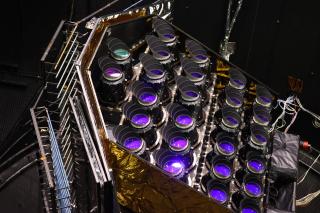
    PLAnetary Transits and Oscillations of stars (PLATO) is the third medium-class mission in ESA's Cosmic Vision programme. Its objective is to find and study a large number of extrasolar planetary systems, with emphasis on the properties of terrestrial planets in the habitable zone around solar-like stars
    Hans Jörg
    Deeg Deeg